Four hours in Talat Noi and Charoen Krung: spare parts, old houses and the ways a neighbourhood keeps working
In Talat Noi, look beyond the weathered wall you might photograph. Parts laid out beside a shop, space left for moving goods, and an entrance rearranged when a house becomes a business can tell you more about the neighbourhood. This four-hour walk starts outside Hua Lamphong MRT station, connects working lanes, old-house exteriors and the Charoen Krung streetscape, and leaves room for lunch and a seated break before returning to the same station.
The question is how the same places continue to be used. This is neither a tour of every house nor a Yaowarat food list. Repair shops are still businesses, and homes still have residents. Careful observation from paths open to the public is enough; entering a workspace is not part of the achievement.
Check what is open, then start the clock outside the station
Meet outside Exit 1 of Hua Lamphong MRT station, somewhere you can stand without blocking the pavement, rather than inside the railway station hall. The Tourism Authority of Thailand's Talat Noi feature uses this exit as a starting point for the Charoen Krung neighbourhood. Before leaving the station, identify the direction towards Talat Noi and Charoen Krung; the return ends outside the same exit. The 30-minute allowance includes finding your way, waiting at crossings and walking. MRT journeys and transfers inside stations are additional. If you need a lift or a route without stairs, ask station staff which exit is suitable; Exit 1 is not presented here as a step-free option.
The example runs from 10:00 to 14:00. Shops and cafes have their own schedules, so check the day's information if a particular business matters to you. In particular, the Talat Noi museum's repair notice covers its building and surrounding area. General hours on the homepage do not establish that you can enter now. This walk excludes museum admission and does not pass through its forecourt garden, pier or construction areas. If the displays inside are your main reason for coming, confirm reopening and plan a separate museum visit. The end of the announced closure period is not, by itself, confirmation that reopening has happened.
Read the parts displays and leave room for deliveries
Begin with streets and lanes open to the public around Charoen Krung 22 and Wanit 2. There is no need to enter an unfamiliar courtyard to make a neat loop. The area's industrial history has a documented basis: the museum's neighbourhood introduction discusses parts work for boats, machinery and rice-milling equipment, along with the trade in old machines. With that context, a shopfront becomes more interesting than a collection of things labelled “scrap metal.”
At a parts shop that is working, choose a small area to examine from outside. Are round pieces grouped together? How are long pieces rested against a wall, and where are the heavy ones kept on the ground? Sorting may reflect size, function or the owner's working habits. You can form a question without inventing a history for every object. If you want to ask what something does, wait until a worker is free and keep the question brief. Move on while goods are being handled.
These 35 minutes include walking between places, not standing in front of one business for the entire period. Step into a safe position to make room for trolleys, motorcycles and unloading. Ask before photographing people, shop interiors or work in progress. Keep your hands out of the parts piles, and do not climb onto objects to take photographs. If the shops are closed, compare frontage widths, entrances and loading space instead. Those features still distinguish a working street from a conventional visitor shopping area.
Look at thresholds before deciding whether to go inside
Next, follow a current map along open lanes towards the old-house exteriors around So Heng Tai. The tourism authority describes this home on Duang Tawan lane as an example of residential space adapted for a cafe and diving activities. That gives context for a change of use; it does not make every room, courtyard or pool freely accessible. The timetable covers street views and places where you are allowed to pause that day. An interior visit is optional, not a required stop.
Try comparing three relationships: where the entrance directs people, how a threshold separates the street from the interior, and whether upstairs windows follow a different rhythm from the ground-floor frontage. What you can see is sufficient; do not reach a camera through a closed entrance. If visits or purchases are available, ask about rules, charges and the areas you may use before deciding whether to spend this part of the timetable inside. Without clear information, keep to the exterior plan.
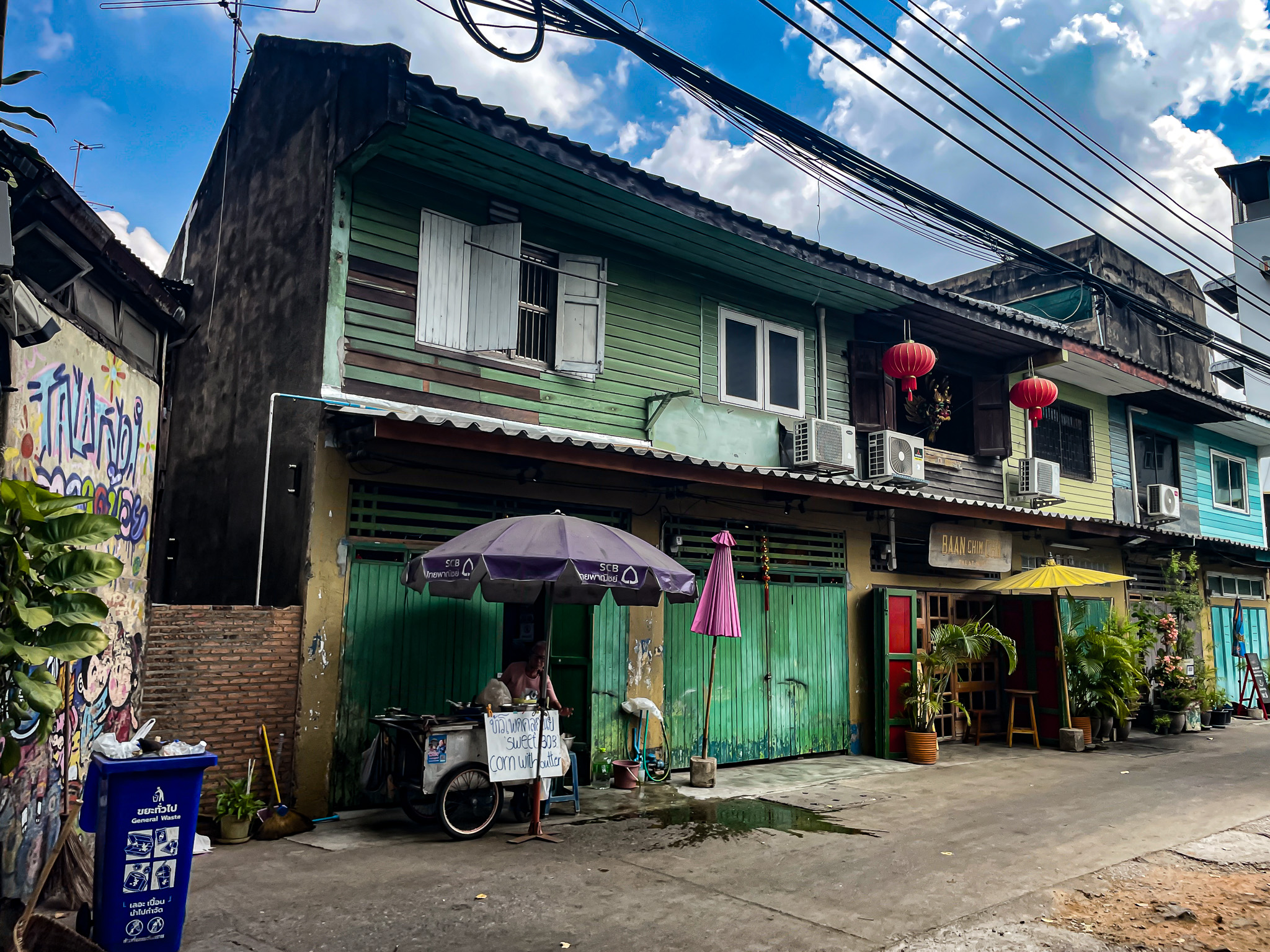
Move your viewing position when residents are coming and going, worshipping or receiving deliveries. An old house matters not only because it has been preserved to resemble the past, but because daily life still passes through it. You can explore that idea without entering private space or asking residents to move out of a photograph.
Budget separate time for lunch and a drink, and find somewhere to sit
Start looking for lunch around 11:40. Check menus and available seats along streets you have already walked, and choose somewhere that suits your budget, appetite and dietary needs. The 45-minute slot includes five minutes of walking, up to ten minutes waiting for a seat and 30 minutes eating. If the likely wait exceeds ten minutes, choose another place rather than letting a famous restaurant take the time reserved for your return.
The following 25 minutes are for coffee or another drink, including finding a place, ordering and sitting down. For a shophouse conversion to research before visiting, TAT's example of Timo and Tintin is useful: an existing shophouse became a cafe, inviting comparison of the entrance, seating and movement between floors. The plan does not include a rooftop climb or promise access to the roof, every floor or an exhibition that day. Buy a drink if there is a suitable seat; otherwise, choose another nearby business that is open. Non-coffee drinkers can select something else. Resting does not require ordering a particular drink.
If your budget covers only lunch, stay a little longer with the restaurant's permission, or bring drinking water and pause somewhere resting is allowed. A business's indoor seats are not automatically free public facilities.
Back on Charoen Krung, compare materials with new uses
Leave the narrower lanes and return to the Charoen Krung streetscape. How much space separates an entrance from the road? Which directions do signs and windows address? When the same brick, metal and wood serve a new purpose, are they hidden, repaired or deliberately left visible? Stay on public paths for this comparison; the walk does not continue to the Grand Postal Building or another arts venue.
The Creative Economy Agency's community street-furniture project documented lighting designs made with damaged vehicle parts and local materials. Treat this as a case study for understanding the neighbourhood, not an object you are guaranteed to find today. Think back to a part you saw earlier: away from its original machine, what else could its shape and weight do? Repair and adaptation then become more than two kinds of photographic backdrop.
Use the last 15 minutes to drink water, confirm your direction and draw your observations together. Choose one place still working in its earlier way and one whose use has changed. If you can describe how each arranges entrances, objects and people's movement, you have a clearer takeaway than a count of sights visited. Start back at 13:30 rather than extending the route for another shop you have just noticed.
How the four hours fit together, and what to cut if delayed
These are editorial allowances for an adult walking at an ordinary pace. They include orientation, movement through the lanes, waiting, a meal and breaks. They are not an officially advertised tour duration, and you do not have to use all the time.
| Time | Plan | Minutes |
|---|---|---|
| 10:00–10:30 | Find your bearings outside Hua Lamphong MRT and walk towards Talat Noi | 30 |
| 10:30–11:05 | Observe parts shops and workspaces in open lanes, including walking | 35 |
| 11:05–11:40 | Look at old-house exteriors and thresholds, including walking | 35 |
| 11:40–12:25 | Find lunch, wait for a seat and eat | 45 |
| 12:25–12:50 | Find a seat, order a drink and rest | 25 |
| 12:50–13:15 | Compare shophouses and uses of materials along Charoen Krung | 25 |
| 13:15–13:30 | Drink water, finish your observations and confirm the way back | 15 |
| 13:30–14:00 | Return outside Hua Lamphong MRT along a passable route | 30 |
If the outward walk or finding your way takes 15 minutes longer, shorten the final 25-minute streetscape comparison to ten minutes, keeping lunch and the return allowance. If the delay reaches 30 minutes, drop that 25-minute comparison and take another five minutes from the closing observations. Retain the water break and the 30 minutes back to the station. If lanes near the old houses cannot be used, return to a street you know is passable rather than squeezing around construction. A shorter walk is a valid outcome.
Costs, weather and the limits of this route
There is no ticketed venue in this plan. Check the conditions before entering a shophouse, joining an activity or making an extra purchase. You might set personal caps of THB 200–300 for lunch and THB 100–200 for drinks and water: THB 300–500 in total. This is a personal budget, not a quotation from any shop's menu. If prices do not fit, change restaurants or skip a purchased drink. Travel and shopping are additional, and there is no compulsory “community pass” in the plan.
In heat, shorten standing observations while keeping a seated break. In heavy rain or a thunderstorm, use a safe indoor space where you are allowed to shelter, rather than a workshop, private porch or construction area; finish early if necessary. Lane surfaces, doorways and crossings differ. This is not a verified continuous step-free route. Anyone needing wider paths or less walking can limit the outing to the Charoen Krung streetscape and one suitable place to eat or drink, without completing every lane.
Before returning, the Bangkok city map can help with your next journey. Purchases are not the measure of these four hours. Remember a part's shape, a threshold and a moment when you made room for someone working, and Talat Noi becomes a place that is still lived in and worked in.