Four hours in Bangkok's old town: look closely at Wat Pho, then take a question to Museum Siam
Wat Pho and Museum Siam make an interesting half-day pairing for more than photographs. In the temple, notice how the Buddha image and the buildings guide your eye. In the museum, ask what makes something seem unmistakably Thai to you, and where that impression comes from. You need not memorise every dynasty, statue name or gallery. A few details understood well can turn the old town into more than a list of sights.
This route starts outside Sanam Chai Station, visits Wat Pho and Museum Siam, then returns to a Sanam Chai entrance. The sample 10:00–14:00 schedule includes walking, ticket queues, lunch and rest. Travel before the starting point and after the return is additional. It leaves the Grand Palace, a ferry crossing to Wat Arun and Thai massage for other plans.
Choose a day when the museum is open
Start with Museum Siam's visitor information. Its regular hours are Tuesday–Sunday, 10:00–18:00, with Monday closure. Check special notices and the exhibition you want before setting out. If the museum is closed, choose another day for the complete route; taking a photograph outside is a different experience from visiting it.
This schedule reaches Wat Pho after ten. For an earlier arrival, consult the temple's visitor information and confirm that day's opening time with the temple. Religious activities may affect access to particular halls, so read the signs on arrival before choosing your sequence.
Dress respectfully for a temple, avoid shorts above the knee and be ready to remove your shoes at religious buildings as directed. Entry, queues and handling shoes all take time; clothing is best sorted before arrival. People come here to worship. Check photography rules, leave statues untouched and keep worshippers' paths clear rather than waiting in their way for an empty photograph.
Four hours, counted from outside the station
Locate Sanam Chai on the Bangkok city map, then use venue maps and local signs to find entrances. The walking allowances assume an ordinary pace, light luggage and no long queues. They are planning estimates, not measured navigation times, and must cover crossings, finding doors and moving through the temple. If you need lifts or a step-free route, ask the station and both venues beforehand; proximity on a map says little about the whole journey's surface and access.
| Time | Plan | Minutes |
|---|---|---|
| 10:00–10:20 | Get your bearings outside Sanam Chai and walk to the Wat Pho entrance | 20 |
| 10:20–10:30 | Buy a ticket, read visitor instructions and allow for waiting | 10 |
| 10:30–11:35 | See the Reclining Buddha and selected architectural details, including walking and taking shoes off and putting them back on | 65 |
| 11:35–11:45 | Drink water and rest somewhere stopping is permitted | 10 |
| 11:45–12:00 | Leave the temple, walk towards the museum area and find lunch | 15 |
| 12:00–12:40 | Choose food, wait and have lunch | 40 |
| 12:40–12:50 | At the museum ticket desk, check galleries and admission and allow for a queue | 10 |
| 12:50–13:45 | Follow two themes in the museum, including movement inside | 55 |
| 13:45–14:00 | Leave and follow a route available that day to a Sanam Chai entrance | 15 |
The total is 240 minutes. The temple's 65 minutes and museum's 55 already include moving around inside. If you walk more slowly, narrow your selection early. Keep the final 15 minutes for the station rather than a last souvenir purchase.
Wat Pho: take in the proportions, then choose one detail
Once inside, use the plan to locate the Reclining Buddha hall and the areas open to visitors. The temple's description of the Buddha image gives its length as 46 metres and height as 15 metres, with auspicious images in mother-of-pearl on the soles. Instead of chasing a photograph of the entire figure, pause where permitted and compare the head, body and hall. How does your eye travel along the figure? How do the columns divide what you see? Keep aware of people behind you when adjusting your camera position.
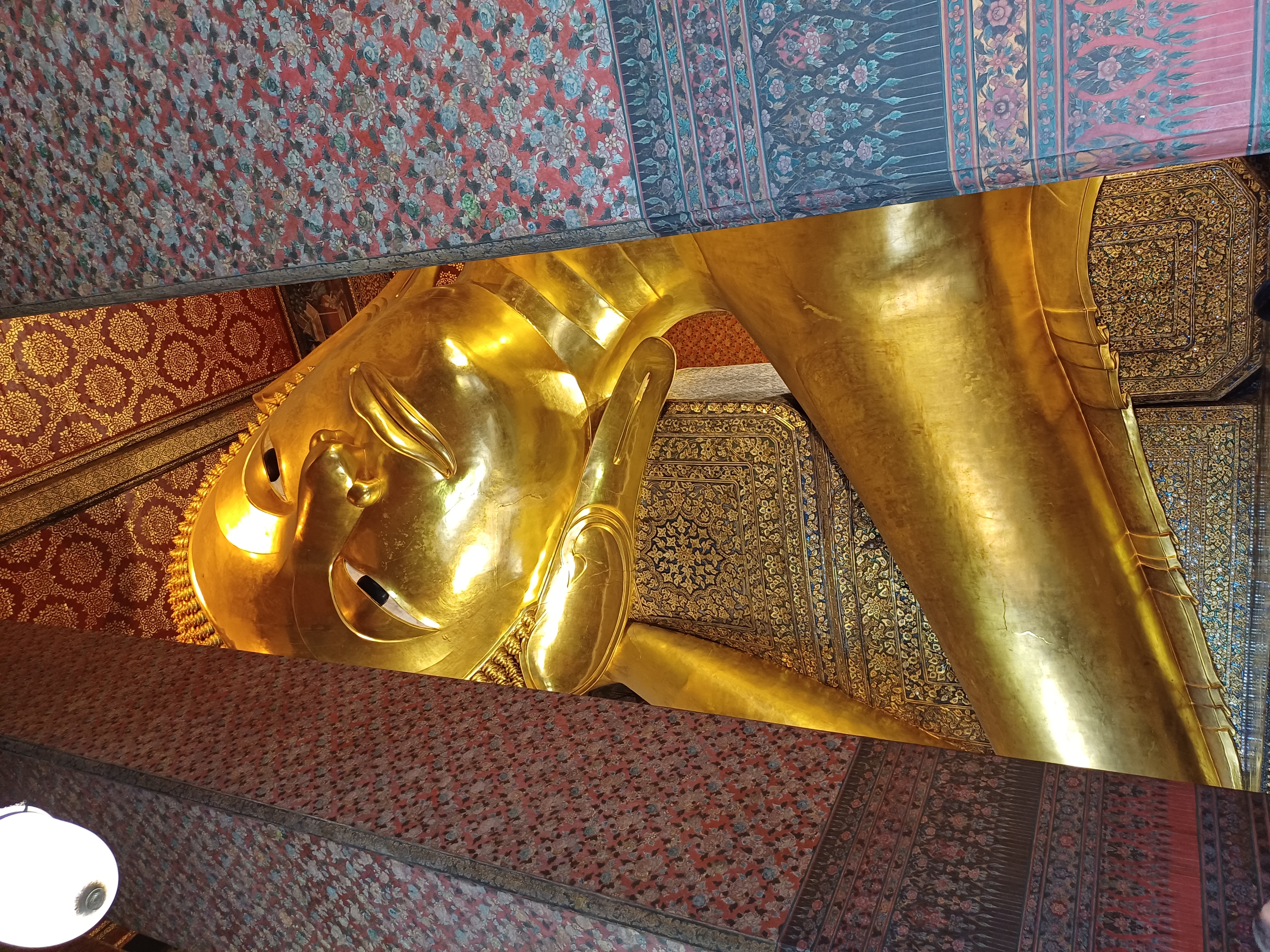
Then look closely at one detail. If the area by the soles is open and uncrowded, examine how the inlaid images are arranged, how the material catches light and how it differs from the surrounding surface. Read the explanation for unfamiliar symbols rather than inventing a meaning for each motif. If access is restricted or the queue is long, explore the proportions from another permitted position. A particular photograph need not become a second queue.
Allow about 30 minutes for the Reclining Buddha hall and another 25 for selected architecture. One option is a group of the large chedis listed in the temple's architectural guide. From somewhere visitors may approach, compare their outlines, colours and arrangement of decoration. There is no need to circle every hall. Those two viewing periods total 55 minutes, leaving ten for walking, taking shoes off and putting them back on, and finding your way. If a ceremony is taking place, give it space and move to an area open for ordinary visits; worship is not a performance to tick off.
Massage at the temple needs separate time for the service and any wait. It is outside these 65 minutes. If massage is your priority, choose another day or change the two-venue plan rather than taking its time from lunch, water or the return journey.
Look at the lunch queue before hunger makes the decision
At 11:35, pause for ten minutes and drink water in a shaded or covered place where resting is allowed. If there are no seats, keep passages clear. After resting, leave the temple towards the museum area. The next 15 minutes cover finding your direction, crossing roads and locating lunch, so they are not a spare sightseeing slot.
Lunch has 40 minutes: ten for choosing and waiting, then 30 for eating. The museum visitor page lists dining facilities and is a useful starting point for research, but restaurants have their own schedules. Check menus, seats and likely service times that day. Choose a simple meal that fits the allowance. If the queue is long, use a nearby alternative you have confirmed is open, or accept a shorter museum visit. Forty minutes will not take you from ordering to departure at every restaurant.
At 12:40, go to the ticket desk to check the day's galleries and language support. If you want a guide device, ask how to obtain it and which languages are available, as well as whether there is a wait. A Thai dish's name, presentation or ingredients from lunch can become a question for the exhibition. One meal, though, is a starting point rather than a conclusion about a whole country's food.
Museum Siam: turn “that looks Thai” into two questions
The museum's Decoding Thainess exhibition explores changing ideas of Thainess through history, architecture, food and clothing. You need not complete an entire national history after the morning's temple visit. Check the day's plan and choose two themes from the areas open. A gallery's online description provides context, while actual objects and working interactive displays depend on what is available during your visit.
First ask, “How do I recognise this as Thai?” If clothing or everyday objects are on display, choose something you thought you knew. Read who uses it, what it does and why it appears in the exhibition. Separate what you can see, what the label explains and what you are associating with it yourself. That distinction is more likely to stay with you than a photograph of every case.
The second question is, “How might different people see the same thing?” If food or perspectives from inside and outside Thailand are covered that day, compare one example with lunch or something you noticed in the temple. Read a complete set of explanations and look for differences across time or contexts of use. There is no need to identify a single definitive symbol of Thailand, or mistake a familiar tourist image for everyone's daily life.
Give each theme about 20 minutes, use five more to finish an explanation, and allow ten for moving around: 55 minutes altogether. When an interactive display has a queue, turn to nearby material you can read. You can leave without trying every button. If the main galleries are closed, decide before buying whether the remaining content still interests you. Reaching the door is not a reason to enter regardless. Finish at 13:45, collect any belongings as directed and head back to the station.
Budget separately for admission and food
For a foreign adult without concessions, the Wat Pho homepage lists THB 300, while Museum Siam's visitor page lists THB 100 for an individual foreign adult: THB 400 for the two. Recheck official ticket information and eligibility before buying. Group rates, student prices and free-entry categories have their own conditions, and older travel accounts may quote different prices.
Set aside a personal food-and-water allowance of THB 150–250, adjusted to your chosen menus. This is a spending plan, not a restaurant quote or a promise of a particular meal. Admission plus food therefore starts at a planned THB 550–650, excluding transport, shopping, donations, massage and separately charged activities. If menus exceed your allowance, change your choice or raise the budget rather than cutting drinking water.
Fifteen minutes late? Narrow the viewing first
If ticketing or the Reclining Buddha queue takes 15 minutes longer and you have not begun the architecture section, reduce that section from 25 to ten minutes. Water and lunch remain. If the delay happens later, time already spent cannot be recovered. Instead, reduce museum reading from 45 to 30 minutes, plus ten for movement, making a 40-minute visit. These are alternatives for different stages, not two cuts to compensate for the same 15-minute delay.
At 30 minutes late, reduce museum reading to 15 minutes on one theme, plus ten for movement. If that feels too brief, save the second venue for another visit. With a greater delay, strong heat, thunderstorms or illness, first rest somewhere safe and permitted, and stop outdoor movement if necessary. Safe crossings matter more than the four-hour target, and hiring a car does not guarantee a quicker return than walking.
If Wat Pho is entirely closed or the museum is shut, another date makes more sense than forcing two stops. The reward here is one temple detail you can describe and one impression the museum has made you reconsider. A flower market, the Grand Palace or a ferry trip is not needed to make those four hours worthwhile.