Four hours in Jakarta’s old town: from Fatahillah Square into the city’s history
Choose one museum and let the square give it context
This outing centres on Fatahillah Square and the Jakarta History Museum, or Museum Sejarah Jakarta. Start outside, looking at the relationship between the square and the former city hall. Then choose a few exhibits to read closely before returning to the square with a little more context. It suits visitors who enjoy comparing maps, objects and labels. If you mainly want to photograph the buildings, make it a shorter walk; there is no need to add more museums simply to fill four hours.
The four hours begin and end in the public areas open to pedestrians around the square. Travel from your accommodation is extra. The old-town route on the existing Jakarta transport map ends at the Kali Besar bus stop; the final walk to the square still needs separate checking. Getting off the bus does not mean you have reached the museum entrance. If you need a step-free route, ask the museum about its entrance and the areas you can reach inside before travelling.
Check opening and admission arrangements for your chosen day. The notice linked from the city government’s museum page lists Tuesday–Sunday, 09:00–15:00, with Monday closed. Another official tourism description gives a different weekend closing time, so this itinerary uses a morning visit and does not rely on extended weekend hours. Confirm any temporary closure, ticket arrangements and areas open to visitors with the museum; closing time should not be treated as the last admission time. The original notice is available through the city government’s museum information. If the museum is closed, visit it another day and keep the square walk as a separate outing.
A four-hour timetable with room for the practical details
This example runs from arrival near the square at 09:00 to a 13:00 finish. The times are editorial allowances, not measured walking times or official required visiting durations. Walking, finding your way, queues, ordering food and resting are included. You still need to choose where to eat; the table cannot guarantee a seat or immediate museum admission.
| Time | Plan | Minutes |
|---|---|---|
| 09:00–09:20 | Get your bearings, find entrance notices and agree on a meeting point for the finish | 20 |
| 09:20–09:45 | Look at the former city hall and its surroundings from the square | 25 |
| 09:45–10:05 | Walk to the entrance in use, check ticket categories, buy tickets and wait to enter | 20 |
| 10:05–10:40 | First look: use maps and city names to build a sense of chronology | 35 |
| 10:40–11:15 | Second look: read selected objects through their uses and users | 35 |
| 11:15–11:35 | Revisit one exhibit, rest, gather your belongings and leave | 20 |
| 11:35–12:20 | Find somewhere to eat, walk there, order, wait and have lunch | 45 |
| 12:20–12:45 | Return to the square and compare what you noticed before and after the museum | 25 |
| 12:45–13:00 | Get water, organise your notes and return to the agreed finishing point | 15 |
The most concentrated reading comes before lunch, leaving a straightforward comparison afterwards. Keep time for eating and leaving the museum instead of spending every spare minute on the early stops.
Read the square before entering the building
The building facing Fatahillah Square was once Batavia’s city hall and now houses the city history museum. Indonesia’s official tourism guide connects the square with the former administrative centre. Looking at the relationship between the building and public space is a useful starting point before deciding where to take a photograph.
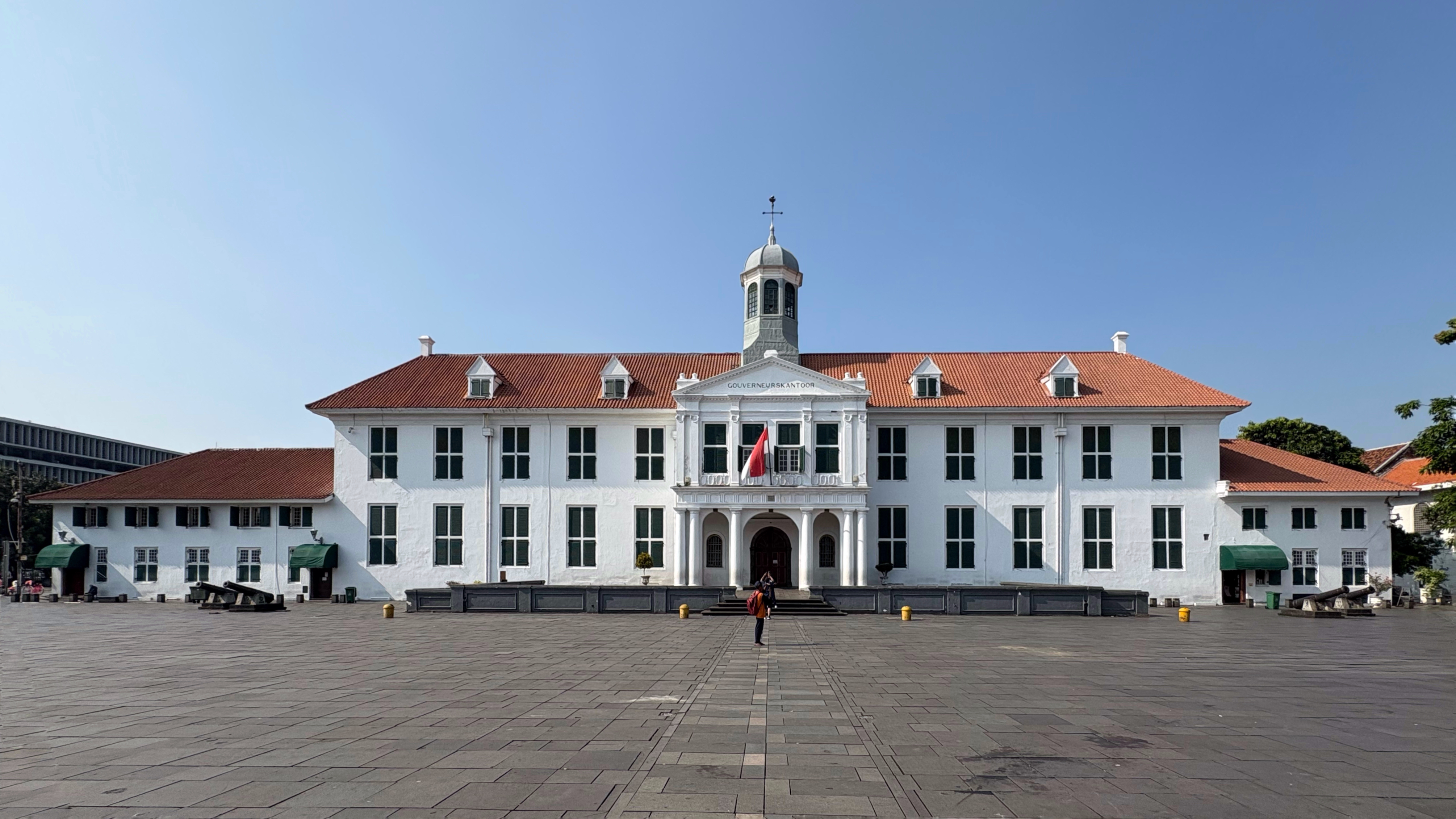
Stand somewhere that leaves room for others to pass. Look first at how the centre of the façade relates to its two sides, then turn towards the square and consider its scale. Why does the entrance stand out? How does the open space in front change the experience of approaching the building? These are questions to explore, not facts to assign immediately to a particular date or purpose. Take them inside and add detail when you find a relevant explanation.
Allow a little time for both photographs and notes. If people or activities occupy the square, adjust your position within the areas open to visitors. A perfectly centred photograph is not a reason to stand in traffic or enter a closed area. Nor does the façade tell you which door currently sells tickets: follow the entrance signs on the day.
Inside: one map, then one object
This is the Jakarta History Museum, a different institution from the National Museum covered in another itinerary. A museum visit reported by the West Jakarta government describes collections including old maps, ceramics and furniture. Use these as themes to look for, rather than a promise that every object mentioned in the report will be on display.
For your first look, find a map, city names or a timeline in an exhibition area open that day. Choose a map whose explanation you can follow. Notice which districts, roads or waterways it includes, then check when and why it was made. Maps from different periods select different information. Similar-looking lines do not establish that an old route follows a present-day road exactly. If there is no suitable map on display, choose an account of the city’s development and note two events in sequence instead.
Next, choose a piece of furniture, a ceramic or another object with enough explanation to work with. Look at its material, shape and size before reading the label. In what setting was it used, and by whom? Is it identified as an original, a replica or part of a later interpretive display? Keep what the label actually says separate from your own suggestions. Furniture can prompt questions about work and domestic life; a vessel can prompt questions about how it was used. There is no need to turn every object into evidence of trade.
Finish by returning to just one object that left you curious. Write a sentence identifying the explanation that led you to your understanding. If a label is difficult to read, ask whether suitable interpretation is available; do not assume a guided tour in a particular language. Stay within the exhibition areas open that day if a floor, special room or basement is closed. This selection does not depend on access to every room. Follow the notices for photography, flash and belongings as well.
Lunch, then another look at the square
The 45-minute lunch allowance includes finding a place, a short walk, ordering and waiting. Read the day’s menu and prices, check anything relevant to your dietary needs, and then decide whether to sit down. If the wait looks too long, choose elsewhere before ordering. This is not a restaurant itinerary, and it does not assume that seats or food will be available inside the museum or immediately beside the square.
Set your own limit for food and water—for example, IDR 100,000 per person in total. That is a personal budget, not a quoted local meal price or set-menu offer; transport and admission are separate. The city notice lists foreign-tourist admission at IDR 50,000, alongside separate adult, student and group categories. Check the category and rate that apply to you on your visit date, rather than choosing the lowest figure or treating a group discount as an individual ticket.
Back at the square, return to one question you wrote down before entering. Can you now say something about the former city hall that is supported by an exhibition explanation? It is equally useful to record what remains unclear. This gives the half-day a connection that rushing into another museum may not. If puppetry, ceramics or another subject catches your interest, allow separate time for it; tickets, movement and reading do not all fit into the last few minutes.
When delayed, shorten the looking rather than the essentials
If you are already 15 minutes behind before entering the museum, reduce the later square comparison from 20 minutes of looking to five, retaining its walking allowance. If you are 30 minutes behind, also take 15 minutes in total from the two museum reading sessions: read less background in the first and focus on one object in the second. These choices apply only to time you have not yet used. A delay later in the outing must come out of the remaining reading or comparison, or mean a later finish; completed activities cannot give you time back.
If admission is unavailable, the weather makes outdoor stops unsuitable or someone is tired, finish early. Another museum does not have to fill the gap. In heavy rain, do not assume any arcade or building beside the square is available as shelter; follow local directions to a safe place where you are allowed to stay. Gather your belongings before leaving and check your onward transport. The route and time from the square back to your transport stop still need a separate allowance. A worthwhile result can be modest: understanding how the square and former city hall face each other, with one map or object adding a chapter to the city’s story.