A day at Elephanta: arrange the return before exploring the columns and carvings
Give Elephanta a full day because the boat journey, the climb and the sculpture each need their own pace, not because you must visit every cave. A substantial part of the day passes on the water; after landing, you still have to reach the caves on the hill. Make Cave 1 your main destination and spend time with two groups of carvings. That can leave a clearer impression than moving from one cave number to the next.
This nine-hour example begins at a boarding point near the Gateway of India confirmed for use that day. It ends after the return to the Mumbai waterfront and disembarkation. Travel between your accommodation and the waterfront is additional. The plan depends on workable outbound and return services, sufficient waiting and climbing time, and the caves being open. If you cannot establish the return arrangements before departure, do not board for the island. The sailing and waiting allowances below are not promises from a boat operator.
1. Ask about the return before deciding to go
Maharashtra Tourism’s Elephanta page describes a boat journey from the Gateway of India followed by steps on the island. It also lists Monday as the caves’ closing day. First check whether the caves will open on your chosen date. Then ask the operator about both journeys, where to report, how early to reach the jetty, and whether sea conditions are affecting services. Do not use this cave-visiting plan on a Monday; on other days, the day of the week alone does not establish normal operation.
Keep the return instructions on your phone or on paper and share them with everyone in your party. Before paying, ask whether the boat ticket covers both directions, whether it is tied to a particular departure, whether cave admission is separate, and which ticket categories apply to you. Unconfirmed boat and admission prices have not been rolled into a total here. You might set a personal food-and-water limit of INR 700, then add the confirmed boat fare, cave admission and any other spending you choose. That is a budgeting example, not a local meal-package price.
If you need a journey without steps, obtain specific arrangements from the operator and site before deciding whether to go. The small train mentioned in tourism information does not establish a step-free route from the jetty to the caves. A mapped upper public approach is also not a verified ticket-checking entrance. Treat boarding, landing and cave admission as separate checks.
2. Give the nine hours to travel, looking and recovery
The table uses elapsed time from the start, rather than departure times for scheduled boats. Work backwards from your confirmed return requirements to decide when you must leave the caves. If the day’s services cannot accommodate these stages, choose another day or reduce the plan. Every allowance is an example that reserves time for moving, waiting, eating and resting; it has not been timed on a walk.
| Elapsed time | Minutes | Stage | Time allocation |
|---|---|---|---|
| 00:00–00:45 | 45 | Confirm both journeys and tickets, wait and board | Information, waiting and preparation 45 |
| 00:45–02:00 | 75 | Allowance for the outward sailing | Boat travel and necessary disembarkation 75 |
| 02:00–03:00 | 60 | Disembark, walk and climb, rest, and confirm admission | Walking 35, information and preparation 15, rest 10 |
| 03:00–03:25 | 25 | Sit down, drink water and decide how to approach the visit | Rest 25 |
| 03:25–04:15 | 50 | Cave 1: columns, space and the principal sculpture | Walking 5, viewing 45 |
| 04:15–05:00 | 45 | Cave 1: compare two groups of carvings | Walking 5, viewing 40 |
| 05:00–06:00 | 60 | Reach a suitable place to eat, order, wait and have lunch | Walking 5, waiting and payment 20, eating 35 |
| 06:00–06:30 | 30 | A short additional look if time allows, followed by rest | Viewing 15, rest 15 |
| 06:30–07:15 | 45 | Leave the caves, descend and return to the jetty | Walking 45 |
| 07:15–07:45 | 30 | Report for the return, wait and board | Information, waiting and preparation 30 |
| 07:45–09:00 | 75 | Allowance for the return sailing and disembarkation | Boat travel and disembarkation 75 |
Neither 75-minute boat allowance guarantees room for every sailing or disembarkation delay. The 30-minute return wait is not a guarantee that you can catch the last boat. If your confirmed reporting requirements mean arriving earlier, leave the caves earlier. Do not finish the final viewing stage and only then start looking for a boat. If the day is likely to exceed nine hours, reassess your return to the waterfront and onward journey. Do not remove necessary walking or waiting simply to make the total fit.
3. Read the space through its columns before turning to the principal sculpture
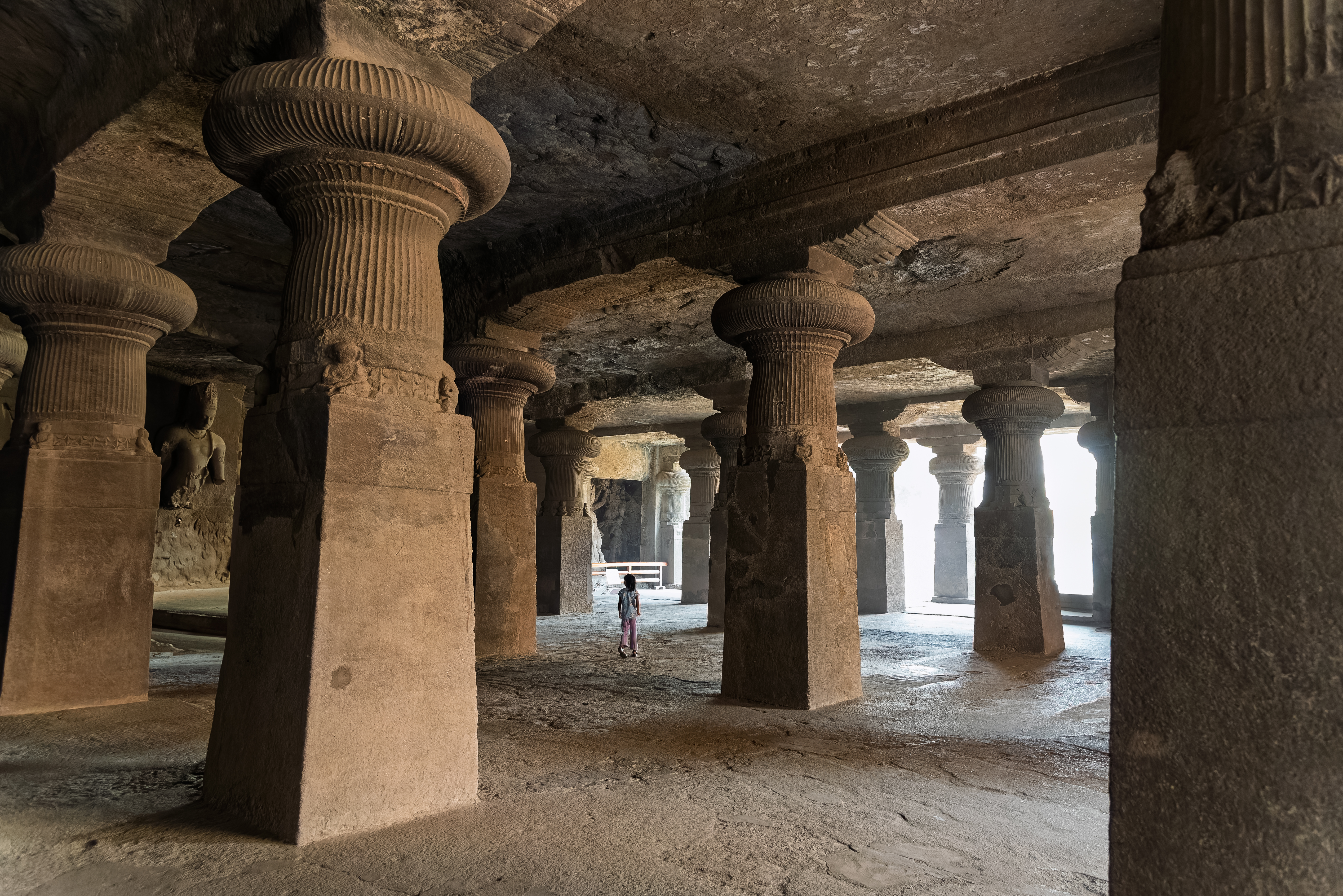
UNESCO’s account of the Elephanta Caves considers the main cave’s spatial arrangement alongside its sculptures of Shiva. Once inside the parts of Cave 1 open that day, stop somewhere clear of other visitors and let your eyes adjust to the light. Notice how the columns form rows, where their shafts and capitals change shape, and how they divide a large space into smaller parts. This is a way to understand the sculptures’ setting before searching for a photograph.
Compare a nearby column with another farther away. Does an apparent difference in width come from its shape, or from distance and light? Then look at the sculptures visible between the columns. A small change of position conceals some details and reveals others. Stay on open routes: you do not need to cross a barrier or approach a carving closely to see this relationship.
The principal Sadashiva sculpture is one focus of the visit. UNESCO explains it through the aspects of creation, preservation and destruction; avoid reducing it to three unrelated gods. Start with the overall outline, then compare the faces, headdresses and directions of the gaze. If interpretation is available on site, connect its names with the details you can see. Leave an unfamiliar gesture or object as a question rather than inventing a story. If the area is closed or too crowded for an unhurried look, choose another permitted viewpoint. Admission does not guarantee proximity to a particular sculpture.
4. Two groups of carvings are enough: compare movement and composition
You do not need to read every story on the walls during the second round. Official cultural descriptions include Shiva as the dancing Nataraja and Ardhanarishvara, combining male and female forms. These can be your two choices if the areas are open and on-site information allows you to identify them. If one is unavailable, choose another visible group that you can identify. Do not cross a boundary to complete a prescribed list.
On the first look, concentrate on composition. Which limbs or surrounding figures draw your attention outwards? Which group first directs your eye towards the central body? Then read the interpretation and find a relationship you missed. Separating what you notice from what the explanation tells you helps you remember a few clear details instead of a long list of unfamiliar names.
Damage to the stone can also be part of what you observe, but do not assign every mark to a period yourself. UNESCO’s conservation account discusses stone, salts and successive repairs. This provides background to the monument’s history, not a confirmed date for every visible repair. Keep your distance, do not touch the carvings, and distinguish visible forms from explanations supported by a source. Religious figures are not props to lean against or mimic for a photograph.
5. Sit down for lunch and save energy for the return to the jetty
The 60-minute lunch stage includes choosing a suitable place, reaching it, ordering, waiting, eating and paying. Look for clear prices, a way to explain dietary requirements and a wait that fits the time available. Check portions and drinking-water arrangements before sitting down. No business is specified here, and no dish or set meal is guaranteed. If a queue is too long, finding another option that allows you to eat within the remaining time is more practical than making the whole day revolve around one place.
The half-hour after lunch combines a short additional look with seated rest; it does not open up a new route to somewhere distant. Recall the two groups of carvings and note one movement and one detail about the columns. If you are tired, make rest the priority. Follow a business’s rules on purchases and seating, and use public resting places only where available that day. Water, a proper meal and enough energy to descend the steps matter more than one extra photograph.
Other caves, distant attractions and Mumbai’s Fort area are deliberately left out of this day. You still need to descend, reach the jetty, report and board. Leaving Cave 1 is not the same as being on the return boat. Walk down at your own pace; if the surface is wet or you are tired, pause somewhere suitable. Do not hurry to recover time spent looking.
6. Reduce viewing that has not begun, or cancel the island visit
If the outward journey or admission runs 15 minutes late, remove the unstarted 15-minute viewing period after lunch while keeping its 15-minute rest. For a 30-minute delay, also shorten the second, still-unstarted carving-comparison stage from 45 to 30 minutes. These reductions come from optional viewing ahead of you, not from time already spent. They do not take away the basic allowance for descending, reporting for the return or eating.
If the delay occurs after those stages have finished, that calculation no longer works. Follow your confirmed return requirements, shorten subsequent viewing that has not begun, or leave earlier. If you land with too little time for a reasonable climb, visit and return, do not continue uphill. Cancelled sailings, unsuitable sea conditions, closures or instructions to leave take precedence: follow the operator and site staff. A nine-hour table cannot provide a safety guarantee.
Before leaving, reread the official access and opening information and establish the day’s return arrangements. A worthwhile day at Elephanta need not include the greatest number of caves. It needs time to understand a few sculptures and enough room in the plan to return comfortably to the Mumbai waterfront.