Four hours in Katong: shophouse shade, a Joo Chiat lunch and a pause by the coast
Katong rewards a slower pace, but you do not need to cover every street of colourful houses. This half-day starts with a short stretch around East Coast Road and Joo Chiat Road: look at how shutters, columns and the projecting upper floor change the light at street level. After lunch, head towards East Coast Park and choose somewhere open and suitable for a pause. First, notice how buildings shelter people on foot; later, compare that experience with the wider views and different demands of an open coast.
Start outside Tanjong Katong station and finish outside the same station. The four hours include finding your way, walking, waiting, lunch and seated rest. Travel to the station beforehand and onwards afterwards is additional. There is quite a lot of walking in this plan. If you mainly want an easy look at the houses and a drink, staying in Katong can be just as worthwhile; the coastal stop is no reason to rush your meal.
1. Keep the street section small and give the half-day clear boundaries
Before setting off, locate Tanjong Katong station, East Coast Road and Joo Chiat Road on a current map, then check the latest notices on the official East Coast Park page. Works affect particular paths, lawns and facilities. When choosing a coastal resting place, match those notices with the barriers and signs on site. The official ground-investigation notice says the park and beach remain open while asking visitors to keep clear of work areas. That does not establish that every approach to the coast is usable as usual.
For the neighbourhood section, concentrate on a small stretch around the junction of the two roads, choosing facades you can comfortably observe from public walking space that day. Once you have found two worth comparing, there is no need to pursue another famous photography street. A smaller area leaves room for detail—and for the journey to the coast after lunch.
| Time | Plan | Minutes included |
|---|---|---|
| 10:00–10:05 | Check the neighbourhood direction and notices outside Tanjong Katong station | Orientation and brief waiting 5 |
| 10:05–10:25 | Walk towards your selected Katong and Joo Chiat street section | Walking 20 |
| 10:25–11:00 | Compare two shophouse facades and the space beneath their shade | Looking 25, walking between positions 10 |
| 11:00–11:15 | Revisit one shutter or row-of-columns detail | Looking 10, walking 5 |
| 11:15–12:00 | Choose lunch in the neighbourhood, eat seated and pause afterwards | Waiting 10, eating 30, resting 5 |
| 12:00–12:40 | Check a usable route and walk towards a coastal resting place | Orientation and brief waiting 5, walking 35 |
| 12:40–13:10 | Look around and rest in a coastal area open that day | Looking 15, resting 10, walking 5 |
| 13:10–14:00 | Leave the coast and return to the outside of Tanjong Katong station | Walking 45, orientation and brief waiting 5 |
The total is 240 minutes: walking 120, looking 50, orientation and waiting 25, eating 30 and resting 15. These are planning allowances, not measured walking times or maximum waits. Check the actual route both to the coast and back to the station. If a diversion makes either leg unsuitable for your available time or energy, stay in the neighbourhood and save the coast for another day.
2. Read the space under the upper floor before looking up at the windows
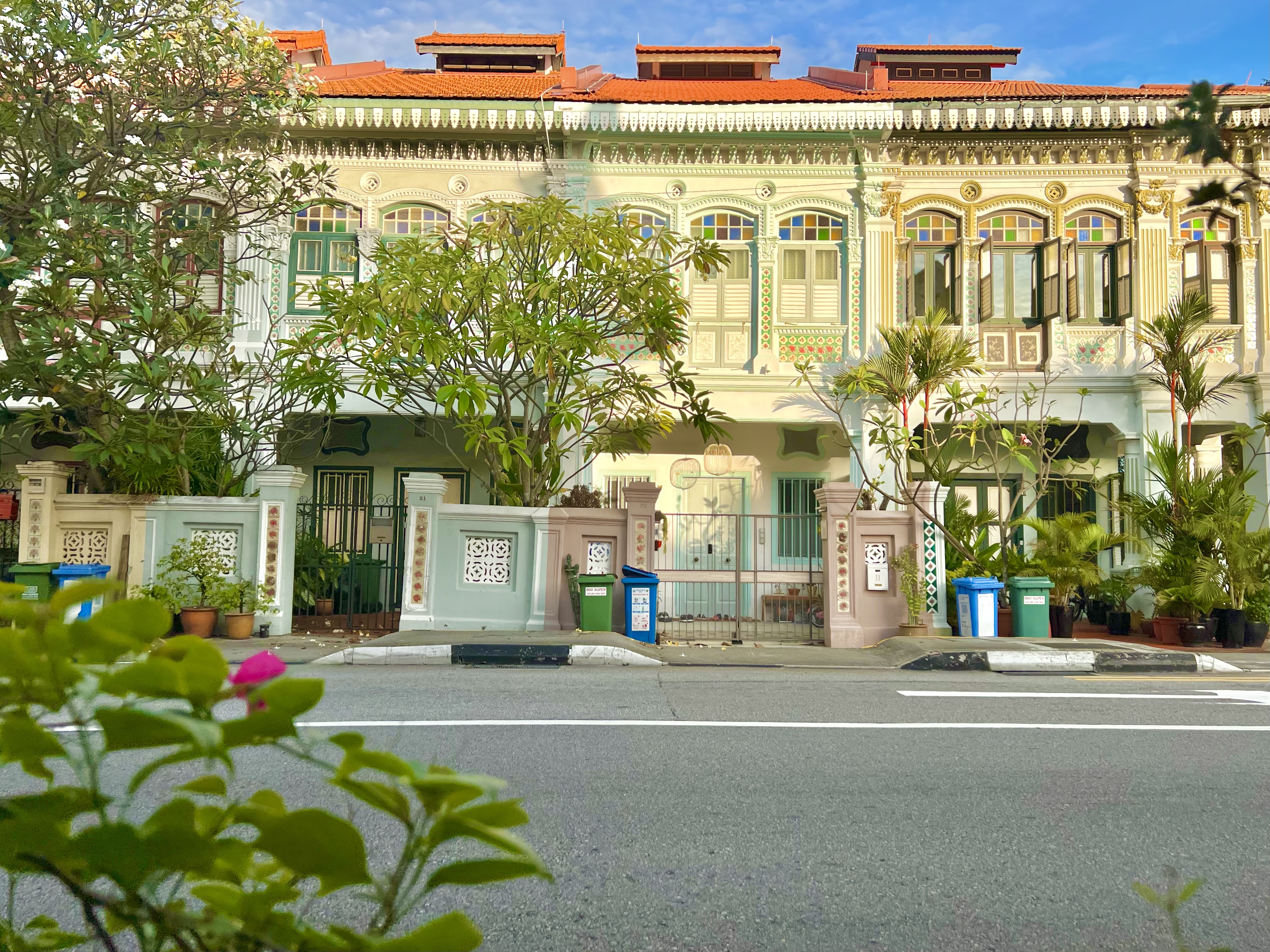
URA's account of the Joo Chiat conservation area describes two-storey shophouses and terrace houses in more than one architectural style. Instead of treating every colourful facade as the same kind of house, begin with a question you can answer from the street: how does this building meet the pavement?
Where shophouses have a continuous covered walkway, stand somewhere that keeps the way clear and look at the relationship between the projecting upper floor, its supporting columns and the space for people below. Choose another nearby facade and compare the spacing of the columns, the entrance and the pattern of shade. You do not need to assign an architectural style. Understanding where shelter is provided and where an entrance needs to stay clear already tells you more than remembering a paint colour.
Then raise your eyes. URA's guide to shophouse construction identifies wooden shutters, columns and upper-storey facades among the features to look for, and explains how the projecting upper floor creates a sheltered walkway below. Compare the proportions of two windows, how louvres sit against the wall, and the rhythm of the upper and lower levels. These are prompts for looking. A particular building's use, its residents' backgrounds and its interior require other evidence.
At residential terraces with gates and forecourts, keep your viewing position in public space. A private forecourt is different from a shophouse walkway; a complete photograph is no reason to step through a gate. If people are entering or leaving a shop, let them pass. Sometimes a brief glance followed by a move to one side is the best way to appreciate a building.
3. Return to one detail, then choose lunch to suit you
Use the next fifteen minutes to look again at one detail on the facades you have just compared. Which window has a denser pattern of divisions? Do the columns break the view into separate bays, or let your eye follow the walkway into the distance? One question is easier to remember than photographs of five more buildings.
Find a lunch place in the neighbourhood that is open and has a suitable menu and prices. Check portions, whether staples are ordered separately and how drinks are priced before deciding. Tell the staff about allergies or dietary requirements and ask whether they can accommodate them. A dish's name or a shop's decoration is not proof of halal certification or ingredients; nor does any community have a single fixed diet.
Allow SGD 15–25 per person for lunch, water and any extra drinks. This is a personal spending allowance, not a quoted set meal or current restaurant price. The main plan uses public streets and the park, with no paid admission scheduled. Transport, shopping and any extra activities are additional. If a queue has already exceeded the allowance, choose somewhere easier to sit down or shorten an observation stop that has not begun after you have eaten. Keep the meal and the rest.
4. Decide whether the coastal leg suits today before setting off
After lunch, check the official East Coast Park map and the latest notices again, using a street map to choose an approach that is usable that day. The park map helps you understand its broad sections and facilities. Whether an approach is open, how long a diversion is, and whether stairs or slopes suit everyone in your group need separate confirmation. This plan does not prescribe a particular underpass or station exit.
If it is too hot, your legs are tired or you cannot establish a clear usable route, leave the coast for another visit. Rest in Katong, look again at a detail you missed or return to the station early. A worthwhile alternative does not have to fill four hours.
Only head towards the coast once you have made that decision. On arrival, establish your return direction before choosing an open area where you can safely pause. Resist following the shore from one attraction to the next as soon as you see the water. A small section is enough to give the neighbourhood visit a different ending.
5. Let fifteen minutes by the coast change your sense of scale
Under the shophouse roofs, columns and shopfronts tend to divide the view into close, manageable pieces. At the open coast, notice how the layers change: the walking space, tree shade and places to sit nearby, then the water and sky farther away. Does that make you want to face a different direction? The point is not to decide which setting is better, but to compare how each affects walking and resting.
Sit down if you find a suitable place, drink some water and recall the window or patch of shade that stayed with you from the street. If seats are occupied, shorten the looking time or move to another suitable open area. The rest should not depend on a particular bench being free. This plan includes no swimming and gives you no reason to approach a work barrier for a better view.
The park's ground-investigation notice asks visitors to follow on-site directions and avoid work areas. If the little stretch you had in mind is unavailable, choose another clearly open place. If none is suitable, turn back; a break need not become another sightseeing assignment.
6. Cut only looking time you have not used, and protect the return
If you are fifteen minutes behind and neither the final street-detail stop nor the coastal observation has begun, cancel the 10 minutes of street-detail observation and shorten the coastal observation from 15 to 10 minutes. Keep the walking allowances for both. A detail stop you have already completed cannot be deducted again. If only the coastal observation remains unstarted, the most you can remove from it is its 15 minutes of looking time.
To recover thirty minutes, all three observations—the first facade comparison, the final detail and the coast—must still be unstarted. Reduce the first from 25 to 20 minutes, remove the 10-minute detail stop's observation and remove the coast's 15 minutes of observation: 30 minutes in total. A delay arising after lunch will usually fail those conditions. Reassess the time left, consider returning from the neighbourhood without adding the coast, or accept a later finish. Check the actual return route afresh; dropping a stop does not necessarily save a fixed amount of walking.
The value of these four hours is the connection between one neighbourhood and a short piece of coast: how shutters and upper floors meet the street, how people move through shade, and where you feel like sitting once the view opens out. One detail you understand can stay with you longer than a list of completed addresses.