Four hours from Gongguan to Shida: a campus walk, a bookshop and an unhurried dinner
For an afternoon in Taipei that leaves room to think, start in Gongguan with a question rather than a checklist: what gets read, discussed and noticed around a university? On campus, the interest is in the way people use space. In a bookshop, it is in the choices behind the shelves. By dinner in Shida, you are back among the everyday business of eating, shopping and getting home.
This walk begins outside Gongguan station, takes in a small outdoor area of National Taiwan University that is open to visitors that day, then visits Tonsan Bookstore before continuing towards Shida Road and Longquan Street. It ends outside Taipower Building station. The example runs from 15:00 to 19:00 and includes crossings, finding places, waiting for food and taking a break. Bitan, a comprehensive campus tour and indoor museum visits belong on another day.
Check campus access and the bookshop before leaving
NTU's Office of International Affairs says visitors may explore the campus independently without applying in advance. That does not open every classroom, library, residence hall or event space to visitors. Check university notices before setting out and follow signs at the entrance. If an area is restricted, use an open path; walking through a building is not an automatic shortcut.
Check Tonsan's own visitor information next. The shop lists its address as B1, No. 9, Lane 333, Section 3, Roosevelt Road, with weekday hours of 10:00–20:30 and holiday hours of 12:00–20:30. An afternoon visit fits those published hours, but temporary changes still matter. The shop is in a basement. If you need a lift or cannot manage stairs, confirm access with the shop first; a short distance on a map says little about getting through the door.
The four-hour clock starts outside the station. Use the Taipei city map to place Gongguan, NTU and Taipower Building in relation to one another, then choose a clear meeting point that does not obstruct people passing. Getting from the platform to street level, train travel and the journey from your hotel all need separate time. No particular exit or fastest walking route is promised here.
Forty-five minutes on campus: choose a small area and look closely
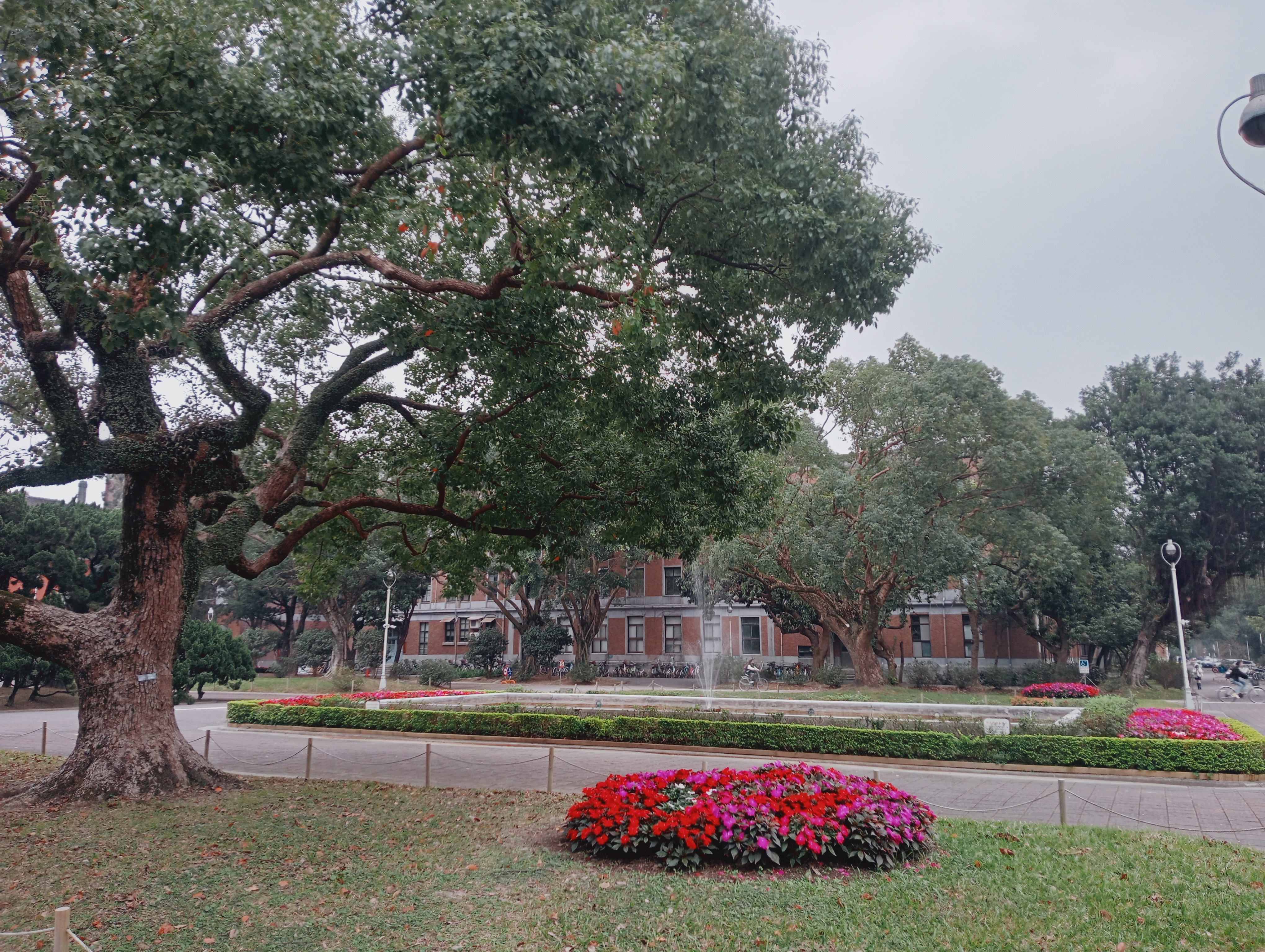
Allow fifteen minutes to orient yourself outside Gongguan station and reach an available campus entrance, including traffic lights. The campus block then gives you roughly thirty minutes to look around and fifteen for moving within the grounds and reaching a suitable way out. Keep to a short, open stretch of Royal Palm Boulevard and nearby building exteriors around the main entrance. Reaching the far end and coming back is not the goal.
The university's tour information recommends at least an hour for a fuller outdoor tour, with extra time for museums. This is deliberately a smaller walk. Notice how the tree rows, junctions and buildings direct your eye. How does a main route feel different from a quieter space beside it? Let students going to class, cyclists and other pedestrians pass. Observing campus life does not require photographing strangers' faces.
For some background, read the NTU History Gallery introduction. The former main library's central reading room, on its second floor, later served other purposes before becoming a place to present university history. It offers a useful question for your walk: how can a building carry the memory of changing uses? The gallery itself is not included in this outdoor route and has separate opening arrangements and visitor rules. If going inside is your priority, make it the focus of the afternoon and reconsider the bookshop and dinner, rather than adding it to an already full timetable.
Shorten the outdoor part if it is hot or wet. If visitors cannot enter the campus that day, stay in Gongguan and choose a bookshop or meal stop that is actually open. Moving on early makes more sense than waiting at a gate just to fill four hours.
Tonsan Bookstore: start with a question, then choose a book
Allow fifteen minutes to leave the campus, cross roads, find the lane and check the shop entrance. Tonsan describes a publishing and bookselling tradition concerned with ideas outside the mainstream and with the rights of less powerful groups. That is a way into the shelves, not a reason to assume every book takes the same position. You do not need a grounding in political theory to browse thoughtfully.
Use the forty-minute stop to follow one subject that matters to you: cities, work, society or culture, for example. Those are browsing prompts, not a promise of particular stock. After looking at the shop's categories and current displays, compare the contents pages of two relevant books. One might begin with individual lives, another with institutions. One may introduce a subject while the other expects prior knowledge. Those differences can tell you more about which book to take home than the titles alone.
If browsing is permitted, try a preface or a short passage. How does the author frame the question, and what material supports the discussion? Ask staff about editions if that would help, allowing for other customers and the work they are doing. Follow signs on sealed books, handling and photography. A note of the author and title is useful; you do not need to photograph pages into a substitute digital copy.
Keep time for paying and putting your things away. Buying something is optional, and a bookshop should not be treated as a reading room with guaranteed seats. Afterwards, take fifteen minutes to drink some water, settle your bags and rest. If you want to buy a drink, finding it and a brief wait must fit within that break. A long queue is a good reason to use the water you brought instead.
Towards Shida: a shopping district is also someone's neighbourhood
Set aside thirty-five minutes for the walk towards Shida, including crossings, navigation and a slower pace when needed. This is a planning allowance, not an official walking time or a route measured on foot. Works, rain or finding suitable access can make it longer. Follow safe pedestrian routes and signals rather than cutting through restricted university grounds or residential entrances.
The Taipei City Office of Commerce identifies Shida Road and Longquan Street as principal streets of the Longquan shopping district, with clothing, food and cafés among its businesses. Spend fifteen minutes on one short section, looking at shopfronts and choosing dinner. Are the menu and prices clear? Is there suitable seating? How long is the wait? You do not have to explore every side lane, and the name “night market” does not mean all businesses share one set of hours.
Homes and educational buildings are close by, so keep paths clear, lower your voice and take rubbish to an appropriate disposal point. Compare this part of the afternoon with Gongguan: after concentrating on books and reading, you are now seeing how meals, clothing and everyday services fit into the same streets. There is plenty to notice without imagining an unchanging, idealised student quarter.
Sit down for dinner, and leave time to get back
Dinner gets forty-five minutes: ten for ordering and waiting, and thirty-five for eating. Choose somewhere open that suits your budget and dietary needs, rather than making one famous queue the only acceptable outcome. Sampling several snacks is possible, but each extra purchase adds another wait and possibly another search for somewhere to eat.
Check portion sizes, prices and any extra charges before ordering. Discuss necessary adjustments with the business directly; a dish name does not establish its ingredients or how it is prepared. If you have already eaten a full meal in Gongguan, a modest snack and a longer rest may be enough. You can finish early rather than eating again to comply with an itinerary.
Budget separately for transport, dinner, drinks and any books you choose. Prices depend too much on those choices for one invented total to be useful, and a student-area reputation is no guarantee that every business is inexpensive. Keep money for food and getting home before deciding how much to spend on books.
The final fifteen minutes are for walking towards your agreed meeting point outside Taipower Building station and finding the entrance. Allow extra if your restaurant is farther away or you walk more slowly. Platforms, gates and waiting for a train are outside this timetable. Whether you leave with a book or just a new question, the afternoon has offered three ways to read a neighbourhood: its campus spaces, its shelves and its dinner streets.
The four-hour timetable, with room to change your mind
| Time | Plan |
|---|---|
| 15:00–15:15 | Meet outside Gongguan station, orient yourself and reach an available NTU entrance |
| 15:15–16:00 | Observe a limited outdoor area for 30 minutes; allow 15 for campus movement and leaving |
| 16:00–16:15 | Cross roads, walk to Tonsan and confirm the entrance |
| 16:15–16:55 | Browse for 30 minutes; keep 10 for questions, payment and packing |
| 16:55–17:10 | Drink water, organise your things and rest |
| 17:10–17:45 | Walk towards Shida, including junctions and navigation |
| 17:45–18:00 | Browse a short stretch, read menus and choose dinner |
| 18:00–18:45 | Allow 10 minutes to order and wait, then 35 to eat |
| 18:45–19:00 | Walk to the agreed point outside Taipower Building station |
These nine blocks total 240 minutes. They are planning allowances, not field-tested journey times. If you start fifteen minutes late, reduce the unstarted campus observation from thirty to fifteen minutes while keeping the movement time. If you start thirty minutes late, also reduce book browsing from thirty to fifteen, retaining time to pay and pack. A delay after the bookshop needs a different response: you cannot reclaim time already spent. Skip the extra fifteen minutes of browsing before dinner and choose a meal directly. For a larger delay, finish later or eat in Gongguan and return from there, rather than rushing crossings, rest or food.
If Tonsan is unexpectedly closed and choosing books was your main reason to come, another day may be the better choice. You can still make a shorter outing of the campus and a meal, but an unfamiliar shop seen en route is not a verified replacement. Anyone needing step-free access should confirm both the basement shop and station connections first; this article does not establish a continuous accessible route. Heavy rain or tired feet are also good reasons to stay within Gongguan. Understanding one small part of the neighbourhood is worth more than completing every pin.