Four hours in Dadaocheng: trading houses, dried goods and the riverfront
Dihua Street is interesting because business still happens inside its old buildings. Look up at a façade, then down at sacks of dried ingredients, tea and fabric, and the shophouse becomes more than a handsome backdrop. At the river, those present-day shops can be placed in the context of a city once connected by waterborne trade. This half-day walk starts with the buildings, makes room for lunch and one or two shops, then visits the wharf before finishing at Daqiaotou Station.
It suits visitors who enjoy looking closely and choosing what to browse rather than buying something in every shop. There is no boat trip, bicycle hire or detour to the Red House in Ximen, and waiting for sunset is not part of the plan. If you intend to buy substantial quantities of fabric or dried goods, drop the riverfront and allow time for questions, packing and carrying your purchases.
A working shopping district, not an attraction with one opening time
Taipei's Department of Commerce describes Dihua Street's trades as dried and regional foodstuffs, traditional Chinese medicinal ingredients, tea and fabric, and identifies Beimen and Daqiaotou as nearby MRT stations. This walk follows part of Section 1 of Dihua Street, but individual businesses choose their own opening days, hours and breaks. A single set of “old street opening hours” cannot stand in for all of them. See the department's Dihua Street district introduction.
If you have a particular shop in mind, check its arrangements before placing it in the browsing slot. Otherwise, begin with the buildings and the types of goods on display. Lunch is around Yongle: choose according to the day's menu, available seats and dietary needs, rather than committing to a famous place with a long queue.
Leave Beimen at 11:00; finish at Daqiaotou at 15:00
The walk begins outside Beimen Station and ends outside Daqiaotou Station. Travel from your hotel to Beimen, and onward from Daqiaotou, is additional. Check a Taipei MRT map to see how your accommodation relates to both ends. Everything on the route is on foot. These are editorial estimates that include food, rest, junctions and time to find your way; reduce the itinerary when streets are crowded or bags are heavy.
| Time | Plan | Allowance and trade-off |
|---|---|---|
| 11:00–11:20 | Walk from outside Beimen Station to southern Dihua Street | 20 minutes walking; do not stop in the roadway for photos |
| 11:20–12:10 | Read the shophouse façades around Yongle | 35 minutes looking and 15 walking locally; leave substantial shopping until later |
| 12:10–12:50 | Lunch | 5 minutes waiting and 35 eating; choose somewhere with seats available |
| 12:50–13:20 | Browse one or two businesses; compare goods and packaging | 30 minutes; no need to make every shop a compulsory stop |
| 13:20–13:35 | Head towards the end of Minsheng West Road and the wharf entrance | 15 minutes walking; check floodgate and access notices first |
| 13:35–14:05 | Wharf and a short stretch of nearby riverbank | 20 minutes looking and 10 resting; no boat trip or bike hire |
| 14:05–14:25 | Return to the streets and head towards northern Dihua Street | 20 minutes walking, using roads open on the day |
| 14:25–14:35 | Drink water, sit down and organise shopping bags | 10 minutes resting; do not add another shop with a queue |
| 14:35–15:00 | Walk to the outside of Daqiaotou Station | 25 minutes; allow more time when carrying heavy purchases |
The total is 240 minutes: 85 for looking and browsing, 95 for walking, 5 for waiting, 35 for lunch and 20 for rest. Keep the final walk to the station intact. Using it to absorb a shopping overrun is an easy way to turn a pleasant outing into a rush with heavy bags.
Read a shophouse in three layers
Choose two or three neighbouring buildings before worrying about architectural labels. Stand clear of shop entrances and compare the width of the ground-floor openings and how signs and merchandise occupy the frontage. Look up: do the windows and decorations still line up with the businesses below? Then examine the sheltered space between street and shop. How do pedestrians, customers and people moving stock make room for one another? These are questions you can investigate for yourself.
A long passage visible from outside an old building is not an invitation to walk through. The Department of Cultural Affairs describes Cheng Le Tong (埕樂通) as a traditional deep-plan shophouse, but the venue listing used for this itinerary records it as closed for renovation. This route does not enter the building, use its passage or rely on its toilets. If passing nearby, look only at what is visible from the public street and stay clear of the works area.
For a sense of the businesses once housed inside, the department's historical account of Cheng Le Tong describes successive traders in regional goods, dried seafood and powdered food products. Take that background back to the street: some spaces display small quantities, while others appear arranged for handling whole sacks. History helps explain the district; an old exhibition-opening announcement does not establish that a building can be visited today.
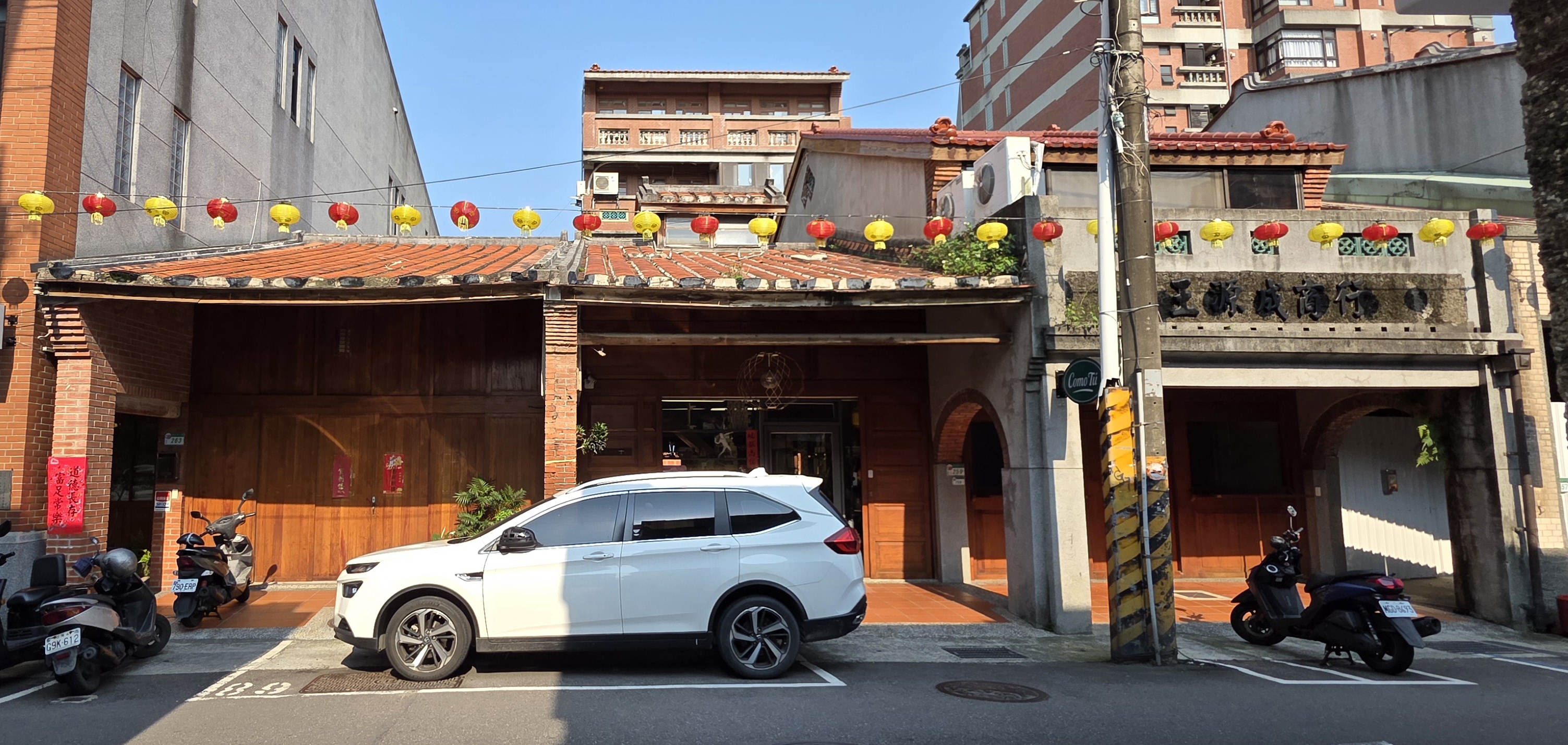
Photo: 阿道 / Original work: 迪化街一段259~265號店屋 20260410 / CC BY-SA 4.0. GoMRT has not modified the file supplied by the photographer. The complete image is displayed at its original aspect ratio and retains its CC BY-SA 4.0 licence.
Browse dried goods by asking about the unit first
During the 30-minute browsing slot, start with something you would actually use, such as a dried ingredient or tea. Ask about the pricing unit, pack size and storage requirements before deciding whether to buy. Comparing the numbers on price labels alone is misleading when one is for a packet, another for a jin, or the goods are different grades. If you are simply curious, read the label and ask a brief question rather than treating a busy trader as an unlimited guided tour.
Each person could choose a familiar everyday ingredient they have not seen dried or sold in bulk. Compare how it is stacked and labelled, and consider why it lends itself to being divided and sold by a trading business. Do not infer medical benefits from medicinal ingredients or buy them as a substitute for medical advice. For allergies, dietary restrictions or food you intend to take abroad, check labels and the relevant rules before deciding.
Ask before photographing shelves, staff or customers, and keep weighing and payment areas clear. If you really want to buy in quantity, cancelling the wharf is more practical than squeezing questions and packing into five minutes.
Read the riverfront as part of the trading district
The Hydraulic Engineering Office's introduction to Yanping Riverside Park places Dadaocheng Wharf around the end of Minsheng West Road and Floodgate No. 5, and explains the relationship between river transport and Dadaocheng's development. At the water, first look back towards the streets you have left. Notice how the embankment, roads and river now form separate layers. A trading settlement once reliant on the river is now reached through specific access points: that change in space is worth considering in its own right.
Choose a short, open stretch of riverbank rather than trying to cover the whole park. Let bicycles pass before crossing their line of travel and sit where you will not block movement. Boats, container food businesses or events, if visible, can illustrate how the riverside is used today. The plan includes no sailing, and does not promise that markets or performances will be operating.
If the floodgate or riverbank is closed, stay on the city side of the embankment. Do not try an alternative entrance that has not been checked. Heavy rain, thunderstorms or uncomfortable heat are also reasons to drop the riverfront and use the time for lunch and a shorter street walk.
What to cut if shopping or walking takes longer
If shopping is unfinished at 13:20, cancel the wharf rather than hurrying towards the water with purchases in hand. If you reach it and find the route unsuitable, return to the streets and keep the remaining time for the station. Do not improvise a bike rental or boat trip to compensate. If lunch queues exceed the allowance, choose a place with space or browse fewer shops; keep the meal.
Holiday and event crowds can change walking speed. Put away your camera and keep shopping bags close when moving through narrow spaces. Wheelchair users, people with pushchairs and anyone who finds long walks difficult should begin by choosing a short section of Dihua Street. Whether the covered walkways and floodgate form a continuous usable route needs checking against actual conditions.
Budget and another way to explore old Taipei
The main route uses public streets and whatever riverside areas are open that day. It includes no paid indoor attraction, boat trip or bicycle hire. Per person, a sample allowance is NT$150–250 for lunch and NT$50–100 for water or a simple drink: NT$200–350 plus MRT travel to and from the route. These are editorial budgeting examples, not quoted shop prices. Set a separate limit for gifts or bulk purchases. Even without shopping, the façades, merchandise and river tell you plenty about the neighbourhood.
For another approach to old-city preservation, consider a separate outing around Longshan Temple and Bopiliao. That walk focuses on a temple and historic shophouses; this one examines a working commercial street and its relationship with the river port. Giving each half a day makes their differences easier to appreciate than repeatedly changing districts within the same outing.