Four hours in Ginza: reading the street through windows, architecture and graphic design
Ginza is a good place to bring a question smaller than a shopping list: how does a shop, or a single poster, persuade you to look a little longer? At Wako, a clock tower, stone facade and display windows come together on a street corner. In a design gallery, lettering and images take the lead. At Matsuya, a broad glass frontage gives way to an atrium that draws your gaze upwards. Connecting these different ways of looking makes for a rewarding four hours, with room to sit down and eat.
This outing starts outside Ginza station, takes in Wako’s exterior and windows, then visits an exhibition you have confirmed is open at ginza graphic gallery, usually called ggg. Afterwards, eat and look at street displays around Chuo-dori, compare the department-store space at Matsuya Ginza, and return to the Ginza station exterior. The subject is commercial display and design, distinct from a Tokyo Station and Marunouchi walk focused on the station facade. A major shopping trip, every floor of a department store, or a second museum deserves its own time.
Choose the exhibition before choosing the day
I would start with ggg’s visitor information, before deciding which day is convenient for shopping. Its usual hours are 11:00–19:00, with closures on Sundays, public holidays and during exhibition changeovers. A department store can be open while the gallery has nothing available to see. Check the exhibition schedule against your visit day. The next exhibition advertised on the homepage may not have started yet.
ggg specialises in graphic design, with different creators, works and questions explored in each exhibition. Read the relevant exhibition page and on-site notices for admission, events, entry arrangements and photography. Even if one show is listed as free, check the one you actually intend to visit. Talks and opening events are separate arrangements from an ordinary gallery visit. This route suits someone willing to choose a few works and give them time; knowing every designer’s name is unnecessary.
Then check Matsuya Ginza’s hours and floor information. General store hours are listed as 11:00–20:00, closing at 19:30 on Sundays or the final day of a holiday period, with special arrangements listed separately. The example below runs from 11:00 to 15:00 and assumes that both the gallery and department store can be visited that day. Restaurants, individual counters and exhibitions have their own conditions.
If you need lifts or less time standing, check the station exit, gallery floor changes and department-store entrance individually before setting out. ggg’s address is 7-7-2 Ginza, on 1F and B1F of the DNP Ginza Building. That identifies the venue; it does not establish a continuous step-free route from the platform to every exhibition space. The four-hour clock starts outside the station. Finding the exit inside and travelling by train require additional time.
Wako: look at the building, then lower your gaze to the windows
Agree on a meeting place outside Ginza station that leaves pedestrians room to pass. Use the first fifteen minutes to orient yourself and walk towards the Ginza 4-chome intersection, following the available streets, signals and entrances that day. This plan does not specify a fastest exit. The Tokyo city map can help you place the neighbourhood beforehand; use station signs to find your actual way out.
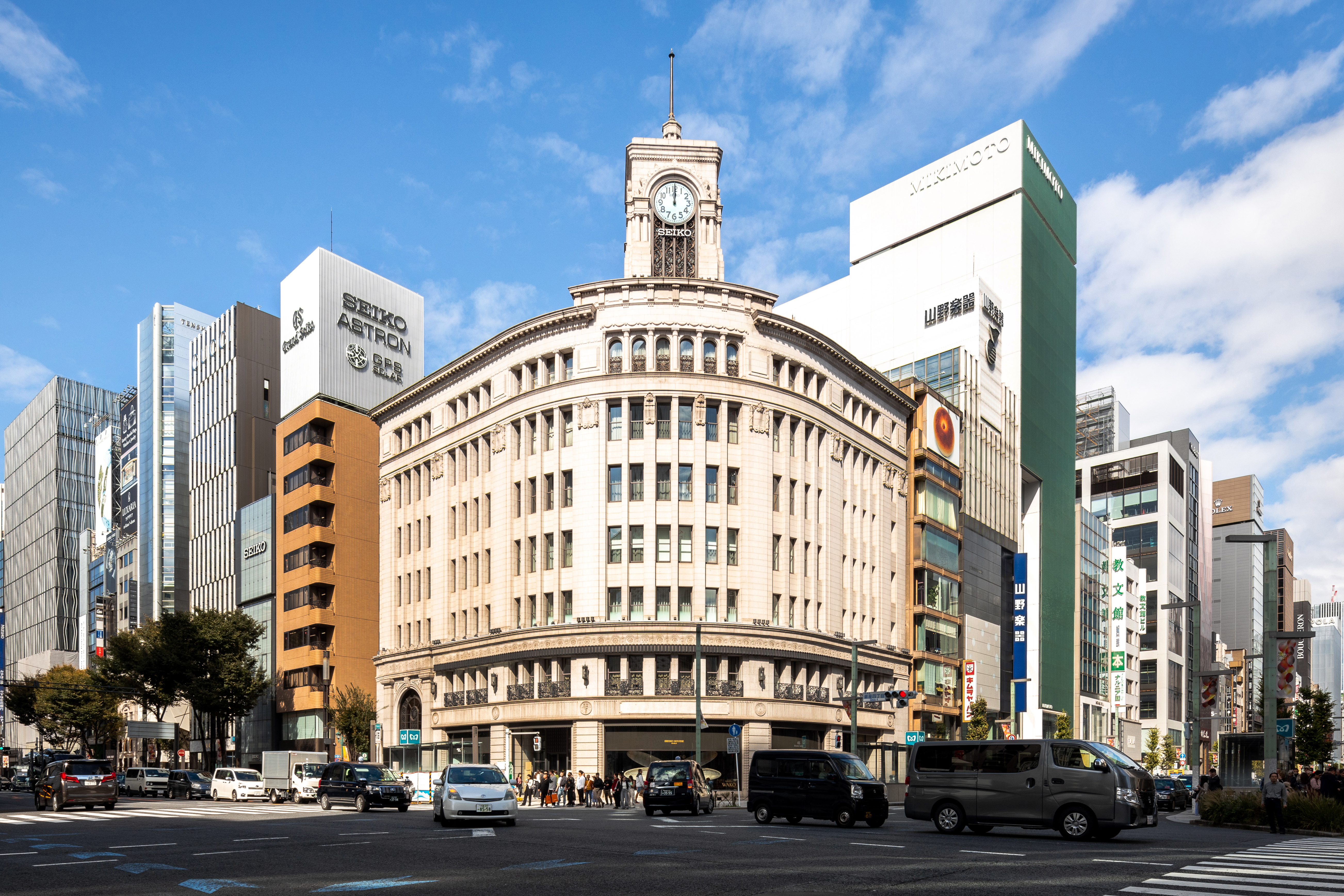
Allow twenty-five minutes for Wako’s exterior and display windows as seen from the public pavement. Wako’s clock-tower history describes the present building as a design by Jin Watanabe’s architectural office, in a Neo-Renaissance style. Its corner forms a gentle curve, the exterior uses natural stone, and decorative details appear beneath the clock faces and around the windows. Start with the tower’s outline, then notice how the building holds your attention at the corner. Finally, look at the proportions of the windows, divisions in the stonework and ground-level shopfront. A safe place where you can pause is enough; a straight-on photograph is not a reason to step into the road.
Move a little closer to look at Wako’s window displays. Before reading a product name, ask what caught your eye first: colour, scale or shape? How much space surrounds the main object? Once you have taken in the whole composition, read the text and consider whether the display is explaining a function, evoking a season or leaving an impression. Displays change. If work or a changeover is under way, concentrate on the building and other visible parts of the street instead of trying to match an old photograph. This stage does not include entering the clock tower or private areas.
At ggg, choose a few works and follow the relationship between words and images
The next fifteen minutes are for walking to ggg, locating the entrance and checking how entry works. The gallery’s access page provides its address and relationship to Ginza station. The travel time in this itinerary is an editorial allowance for the walk, crossings and finding your way, rather than a measured navigation instruction.
Give the gallery fifty minutes: ten for entry checks, a possible short wait and movement within the building, then forty for looking at the work. If entry clearly requires longer, decide how much extra time you can allow before joining the wait. That is better than discovering inside that the whole exhibition has become a hurried circuit. Moving between floors also takes time when the display uses more than one level.
I would choose three works that particularly interest you rather than attempt every label. Start with layout: where do the headline, image and smaller text sit? Then consider the reading order. Which words did you notice first, and what carried your eye to the next element? Finally, think about material and use. How would viewing distance and attention change if the same design appeared on a book cover, a package or a street poster? Choose questions that fit the actual works; not every exhibition will contain all those formats.
From the labels, remember one creator’s name, one treatment of lettering or one colour combination to compare with the street afterwards. Follow the venue’s rules for photography, approaching exhibits and phone use. If photography is not allowed, retaining a single detail is enough. As you leave, you have another way to look at a shop window: alongside “Do I like it?”, ask “Who is meant to notice what first?”
At lunch, give looking a rest
After the exhibition, leave fifteen minutes to exit, walk towards nearby places to eat and find a restaurant. Choose somewhere open that day with a menu and prices that suit you, checking seats, waiting time and dietary needs. Ginza offers plenty of possibilities, but joining a long queue at a popular restaurant need not become another required stop on this walk.
The meal allowance is forty-five minutes: ten to order and wait, thirty-five to eat seated. If the expected wait is longer, you can choose a simpler nearby meal before ordering. Once you have ordered and cannot shorten the wait, adjust the later browsing. Then take a separate fifteen minutes to drink water, organise your belongings and rest. Check how your feet feel before continuing. Buying another drink may involve both extra spending and another queue.
Separate your budget into food, water or other drinks, transport, any costs associated with the chosen exhibition, and optional shopping. Set aside enough for eating and resting before deciding whether to buy books or other goods. No restaurant is specified here, and no particular amount is presented as a guaranteed Ginza meal price. Check the total, extras, service charges and other applicable costs before ordering. Department-store food floors can be enjoyable to browse, but takeaway food does not automatically come with somewhere suitable to sit and eat; confirm the dining arrangements too.
Towards Matsuya Ginza: bring the gallery’s questions back onto the street
The forty-minute stage after lunch and rest includes walking towards Matsuya Ginza, waiting at signals, looking at a short section of street displays, and viewing the atrium from a place where you may pause inside. Allow fifteen minutes for movement and twenty-five for observation. Choose just two displays along the way. Does one put lettering first, while another relies on the size of an object or the space around it? Comparing them with a work you remember from the gallery makes the relationship between advertising, products and viewers more tangible.
Matsuya Ginza’s architectural notes describe its street-facing glass facade and the central, multilevel Space of Ginza atrium. From outside, look at the scale created by that broad glass surface. From an open visitor area inside, notice the edges of the floors and the vertical movement, then compare them with Wako’s curved stone corner. One building can hold your attention at a junction; the other suggests a horizontal spread before drawing your gaze upwards inside. These are ways of looking you can try on the day, without turning architecture into a test of historical dates.
The facade lighting described by Matsuya is a different, evening expression of the building. Seeing it illuminated is not a condition of this daytime route. If an event, display or crowd obscures the atrium, use whatever viewing position is available. Keep escalator landings clear rather than stopping there for a complete view. The forty minutes do not cover the rooftop, every floor or another exhibition as well. If a particular design exhibition inside the store appeals to you, verify its dates, floor and entry arrangements, replace an existing part of the itinerary with it, and recalculate the time for going upstairs and waiting.
Use the final twenty minutes to check your direction and return to the agreed point outside Ginza station. Entering, finding the platform and waiting for a train are additional. Think back to the design decision that stayed with you: the tower at the corner, space in a window, the reading order of a poster, or the change of view in the atrium. One remembered detail can give the half-day its own focus.
The four-hour timetable, with choices for rain, changeovers and delays
| Time | Plan |
|---|---|
| 11:00–11:15 | Meet outside Ginza station, orient yourself and walk towards the 4-chome intersection |
| 11:15–11:40 | Look at Wako’s exterior and windows |
| 11:40–11:55 | Walk to ggg and locate the entrance |
| 11:55–12:45 | Allow 10 minutes for entry checks, a short wait and movement inside, then 40 for the exhibition |
| 12:45–13:00 | Leave the gallery, walk and find somewhere to eat |
| 13:00–13:45 | Order and wait for 10 minutes, eat seated for 35 |
| 13:45–14:00 | Drink water, organise belongings and rest |
| 14:00–14:40 | Allow 15 minutes to move towards Matsuya Ginza and 25 for street displays, facade and atrium |
| 14:40–15:00 | Return to the agreed point outside Ginza station |
The nine stages total 240 minutes, starting and ending outside the station. Walking and waiting are editorial allowances, not a route timed on foot or an official fastest itinerary. Rain, wheelchair access, roadworks or finding a lift may lengthen a journey. Reducing the number of things you look at is more comfortable than trying to walk faster.
If you start fifteen minutes late, reduce the Wako stage, before it begins, from twenty-five to ten minutes. If thirty minutes late, also reduce the final observation period from twenty-five to ten, retaining its fifteen minutes of movement. When a delay happens after the gallery or lunch, adjust only time you have not yet used. You can shorten or omit the final observation period, but time already spent at Wako cannot be recovered. If more time is still needed, accept a later finish or find a closer return option whose availability you have confirmed. Keep safe crossings, the meal and necessary rest intact.
If ggg is closed or changing exhibitions and design is your main reason for coming, another day is the clearest choice. If you still want to walk that day, keep Wako, lunch and Matsuya’s architecture, making the outing shorter. Time without gallery access should not be treated as another exhibition that has somehow been completed. Before substituting a different venue, verify its opening and entry conditions and recalculate the travel.
In rain, reduce time lingering at street windows and focus on the gallery and store you have confirmed are open. The paths between them may still be exposed: indoor destinations do not make the whole route sheltered. If wind or rain makes walking difficult, or your feet are tired, eat earlier, return to the station or choose another day. Ginza’s appeal here is the chance to look at design on different scales along the same streets. You can find that at a slower pace too.