Four hours from Meiji Jingu to Omotesando: forest paths, street trees and a building you can read by walking
Start with the forest, then notice how a street draws you into a building
Meiji Jingu and Omotesando make a rewarding morning together, with more to compare than a quiet shrine and busy shops. On the approach to the shrine, tree canopies, bends in the path and torii gates change what you can see ahead. Out on the avenue, street trees, building heights, entrances and windows take over. Keep one question in mind through these four hours: how does a route encourage you to slow down, then lead you onward?
Begin outside Meiji Jingu's Harajuku-side entrance. Walk the southern approach and the worship areas open that day, return towards Harajuku, then choose a stretch of Omotesando to observe. Omotesando Hills is the one commercial building to study in detail. Finish outside its entrance, somewhere clear of passing pedestrians; allow extra time for your onward journey to a station or accommodation. Leaving out Takeshita Street, Shibuya and a string of brand stores gives the forest, lunch and architecture room of their own.
First check Meiji Jingu's opening and closing times. General shrine admission is free, but gate times vary by month and individual facilities have their own hours. This route does not enter the Inner Garden or Meiji Jingu Museum. If a garden or exhibition interests you more, plan a separate visit after checking its admission arrangements and opening status. At Omotesando Hills, the operator's hours page lists shops and cafés as opening at 11:00, with exceptions for individual businesses and occasional closing days. Visiting the shrine first and looking at the building after lunch makes better use of the morning than waiting outside unopened shops.
Four hours that include walking, waiting and lunch
The schedule runs from 09:00 outside the shrine's Harajuku-side entrance to 13:00 outside Omotesando Hills: 240 minutes in total. These are planning allowances, not measured walking times or maximum queues. Add time for transport to the Harajuku area, finding your station exit and getting to a station afterwards. Before setting off, use the official precinct map to locate the southern approach, shrine buildings and Harajuku side, then follow signs on the day. This route does not specify a station exit, and continuous step-free access has not been confirmed.
| Time | What to do | Time allowance |
|---|---|---|
| 09:00–09:15 | Check the map outside the entrance and enter the approach | Orientation and a short wait 5 minutes; walking 10 |
| 09:15–09:50 | Look at canopies, bends and views framed by torii on the southern approach | Walking 15 minutes; observation 20 |
| 09:50–10:15 | Study buildings and courtyard space in the areas open to worshippers and visitors | Waiting 5 minutes; observation or optional worship 20 |
| 10:15–10:35 | Return towards Harajuku on paths open to visitors | Walking 20 minutes |
| 10:35–10:50 | Drink water and rest in a designated eating and drinking area | Rest 15 minutes |
| 10:50–11:15 | Move onto Omotesando and compare trees with the streetscape along one stretch | Walking 15 minutes; observation 10 |
| 11:15–12:00 | Choose an open place for lunch | Walking to find a place 5 minutes; waiting and ordering 10; eating 30 |
| 12:00–12:40 | Look at Omotesando Hills outside and in the shared interior areas open that day | Walking 10 minutes; architectural observation 30 |
| 12:40–13:00 | Return to the street, revisit one detail and finish outside the entrance | Observation 10 minutes; walking 5; rest and getting ready to leave 5 |
Crowds at the shrine can make the initial wait longer than five minutes, and a lunch table may take more than ten minutes to find. If that happens, shorten an observation stop that has not yet begun, using the adjustments below. When your legs or the weather make the walk uncomfortable, find a suitable place to rest first. The timetable is not a reason to keep pushing on.
The southern approach: looking at a forest that people created
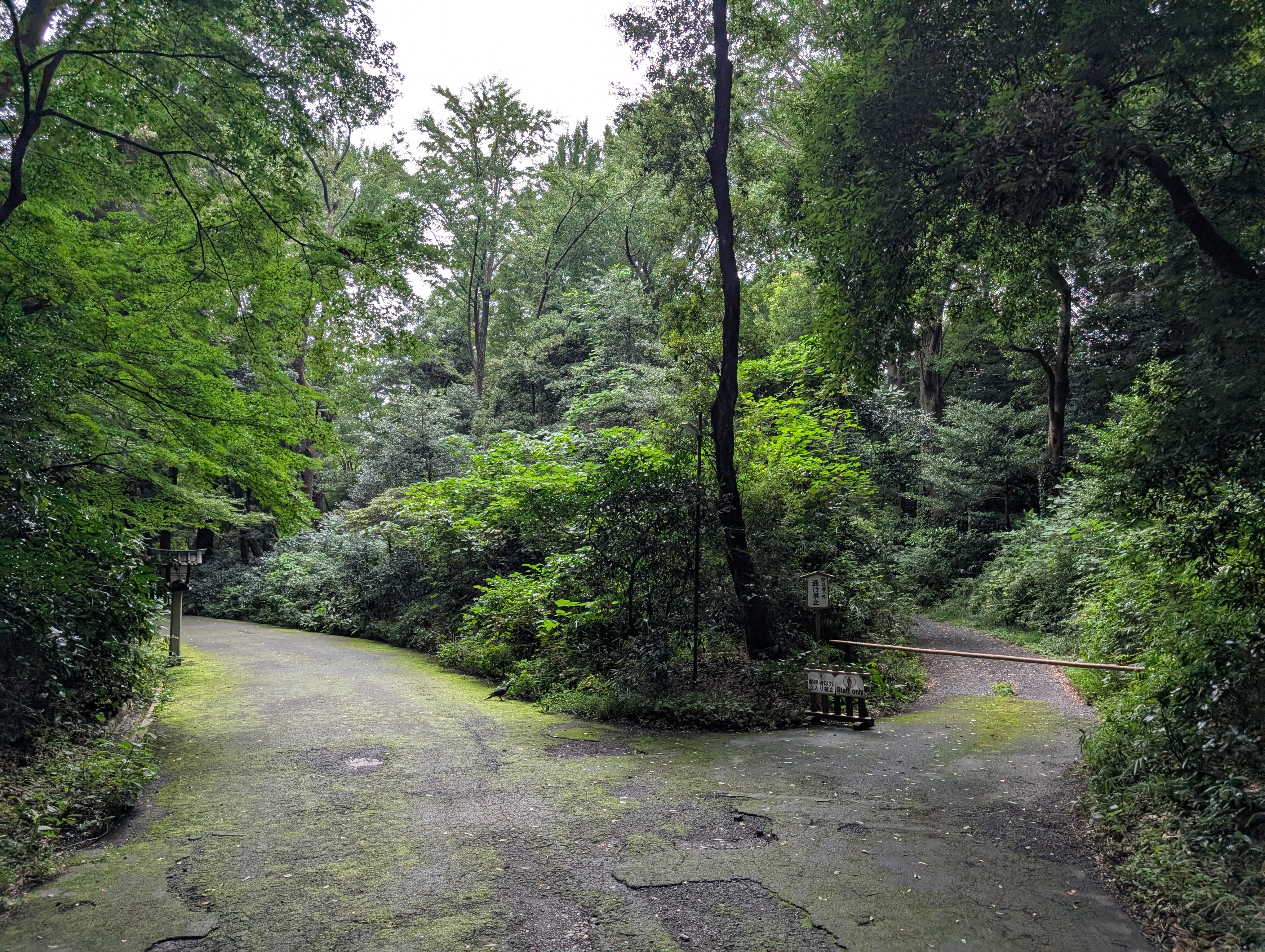
Meiji Jingu's official visitor information explains that its extensive forest was created by people. That gives you something more specific to consider than the surprise of finding so many trees in Tokyo. How much sky do the canopies cover? Does a distant building stay visible as you walk, or do trees and bends briefly hide it? How does the view through a torii change as you approach it and pass beneath it?
Choose two or three places where you can pause without blocking anyone. Look up at the layers of foliage, then lower your gaze to the boundary between the path and the trees. You can make these comparisons from the normal approach. Shrine rules prohibit entering the forest interior, collecting branches or leaves, and bringing living things into or out of the forest. There is no need to leave the path for a more convincing forest photograph.
In the worship area, the scale of your observation shifts from canopies to eaves, courtyard space and the distance between people. Compare the enclosed feeling of the tree-lined approach with places where your view opens out. Meiji Jingu is dedicated to Emperor Meiji and Empress Shoken and remains a place where people come to pray. Join in if you wish, following local guidance, or simply look quietly. A stranger's ceremony need not become a scene you feel obliged to capture.
Read the shrine's questions and photography guidance before taking pictures. Photography is prohibited in front of the main shrine where people pray, and visitors are also asked to refrain from photographing the amulet office. Eating and drinking are limited to designated areas, and there is no suitcase storage within the grounds. These details matter when planning: arrive with manageable belongings and save your water break for an appropriate place. Follow the other notices you encounter on site.
Back on Omotesando, let lunch mark a change of pace
On your return, you can pass the torii without stopping at every one again. Instead, take one question out with you: what made you look up along the way—trees or buildings? Ask it again on Omotesando and the answer may become more complicated. The avenue still has its trees, but entrances, signs, window frames and passing people pull your attention in different directions.
Choose a side of the avenue where you can walk safely, rather than repeatedly crossing to collect more buildings. Find a place where you can see a building's upper edge alongside the trees. Does the building meet the street closely, sit farther back, or show you its interior through glass before you enter? Treat a shop window as a layer between building and street, not an invitation you must accept every time.
The 45-minute lunch slot includes finding a place, waiting and ordering. Choose according to what is open, menu prices and available seating, and ask the business directly about allergies or dietary needs. A personal allowance of JPY 2,000–3,000 for lunch, water and one additional drink is a budgeting choice, not a fixed local set meal or a promise about current prices. Transport, shopping and any separately chosen paid attraction are extra. If a queue exceeds your allowance, choose another suitable place or shorten the later architecture stop; avoid turning the whole meal into something eaten on the move.
Omotesando Hills: carrying the street's slope indoors
One commercial building is enough for a closer look after lunch. The operator's architectural account offers a useful starting point: Tadao Ando's design uses underground space to keep the building's height close to the avenue's zelkova trees, while the Spiral Slope around its central atrium echoes the gradient outside.
Start outdoors before heading into a shop. Bring the roofline and tree canopies into the same view, then notice how entrances draw people in from the avenue. If the building is open, walk a short section of the slope within the shared areas visitors may use. As your position rises or falls, how do the opposite levels, railings and open atrium relate to one another? This can reveal how walking changes your view more clearly than trying to cover every floor.
The official account also explains that the Dojunkan recreates aspects of the former Dojunkai Aoyama apartments. Think about how a neighbourhood's memory is carried forward, rather than treating the entire complex as an old building preserved intact. Shops, exhibitions and events change; the route does not depend on a particular show or brand. If the complex is closed, look at the exterior and finish earlier or return another day, instead of filling the spare time with more shopping centres.
If you run late, cut observation time that is still ahead
At the end, return to the street and look again at one detail: the indoor slope, the relationship between an entrance and the pavement, or the building's upper edge beside the trees. Connecting the morning's shrine approach with the street in front of you gives the half-day a thread of your own, beyond passing through two named places.
If you are 15 minutes behind and have not started the Hills architecture stop, reduce its 30 minutes of observation to 15 and keep the ten minutes of walking. To save 30 minutes, both the architecture observation and final revisit must still be ahead of you. Remove 20 minutes of observation at Hills and cancel the final ten-minute revisit, retaining all the walking, eating, rest and preparation time in the table.
You cannot reclaim time already spent. If a delay occurs later, cut only observation that genuinely has not begun, or accept a later finish. In rain, during temporary access restrictions or if you feel unwell, finish from a safe place and reconsider your onward journey. The reward here is noticing how trees, routes and buildings affect the rhythm of walking. Leaving yourself some breathing room makes that easier to see.