Two hours in Tsim Sha Tsui: the Clock Tower, film handprints and a waterfront with stories to tell
On a first visit to the Tsim Sha Tsui waterfront, it is easy to focus on the towers across the harbour and reach the end of the Avenue of Stars without much sense of what you have seen. This walk takes a different pace. Instead of collecting every celebrity handprint, start at the Clock Tower to think about how travellers once arrived in Kowloon. Then choose two people from the world of film and connect the waterfront scenery with Hong Kong’s screen memories.
The route starts outside Tsim Sha Tsui Station, passes the Clock Tower and waterfront promenade, and finishes outside East Tsim Sha Tsui Station. It includes no ferry trip, art museum visit or Space Museum programme. It suits travellers who have already had lunch and want some time outdoors. If you use a wheelchair, have a pushchair or are carrying luggage, choose suitable station lifts and passages in advance. Starting outside the station does not mean every MTR exit involves the same walk.
Three ways of looking in two hours
Think of the Clock Tower as a way to explore movement, the Avenue of Stars as a place to discover people, and the harbour as a place to notice distance. The Hong Kong Tourism Board’s Tsim Sha Tsui promenade guide brings the Clock Tower, Cultural Centre and Avenue of Stars together along one waterfront walk. Understanding how they sit in relation to each other saves you from having to find your bearings again at every stop.
The main route stays in outdoor public spaces, with no paid programmes or sightseeing cruises. If a major event brings road closures or crowd controls, follow the signs on site and shorten the walk. Do not enter a closed area just to find a handprint. Afternoon light and the harbour breeze can change quickly; a hat, drinking water and an easily reached jacket are often more useful than squeezing in another attraction.
A 14:00–16:00 schedule
These are editorial estimates based on an ordinary walking pace and normal waits at crossings. Time for photo queues, rest and finding the station is included. Walking from a platform to the station exit, travel to and from your accommodation, and queues for temporary events are not.
| Time | Plan | Time allowed |
|---|---|---|
| 14:00–14:15 | Walk from outside Tsim Sha Tsui Station towards the Cultural Centre and Clock Tower | 15 minutes walking |
| 14:15–14:35 | Look at the Clock Tower’s exterior and its relationship to the harbour | 20 minutes looking |
| 14:35–14:50 | Follow the waterfront towards the Avenue of Stars | 15 minutes walking |
| 14:50–15:25 | Find the handprints and introductions for two people from the world of film | 30 minutes looking, 5 minutes waiting for photos |
| 15:25–15:40 | Drink some water and sit looking out over the harbour | 15 minutes resting |
| 15:40–15:50 | Look at the harbour from another angle | 10 minutes looking |
| 15:50–16:00 | Follow signs away from the waterfront to the outside of East Tsim Sha Tsui Station | 10 minutes walking |
That adds up to 60 minutes looking, 40 moving, 5 waiting and 15 resting: 120 minutes in all. The final ten minutes assume you have not continued to a distant end of the waterfront, away from the station passages. Start watching for station signs at 15:40 rather than waiting until 15:50 to open a map.
The Clock Tower: imagine the station around what remains
Near the Clock Tower, find a spot where you can see both the tower and the public space around it. Notice how the red brick and paler stone create distinct layers, then look up for the clock face. There is no need to fit the entire crowd into your photograph or keep stepping backwards for a better angle. The Tourism Board’s account explains that the tower was once part of the Kowloon–Canton Railway terminus. The station is no longer there, but the tower remains.
Ask yourself which direction a traveller carrying luggage might have looked first when changing from an overland journey to the harbour here. Then turn towards today’s piers, Cultural Centre and pedestrian spaces. That question can make a handsome clock tower a starting point for understanding changes in the city’s transport. This walk is about reading the exterior: it includes no climb up the tower and makes no promise of access inside.
On the way to the Avenue of Stars, notice how some waterfront buildings meet the shore with curved forms and others with blocks. The Cultural Centre and art museum are nearby, but today they serve as landmarks for finding your way, rather than extra visits to squeeze in. If you really want to go inside a museum, replacing this short waterfront walk with a separate half-day plan would work better.
The Avenue of Stars: two people can reveal different roles in film
At the handprints, read the names before deciding what to photograph. Choose one person whose work you have seen and think about the character, scene or voice you remember. For the other, choose an unfamiliar name and read the introduction on site. You can turn this stretch into a thoughtful film walk without stopping for a photograph at every name along the railing.
The QR codes beside the handprints offer information about the people featured, and some entries also link to videos. If your connection is poor, read the text on site rather than spend your time reloading pages. An unfamiliar name does not mean an unimportant contribution. Cinema involves more than the stars in front of the camera; noticing the different jobs in the introductions can give you another way to look at it.
Before photographing a sculpture, check whether someone nearby is already framing a shot. When it is your turn, one or two angles are enough. For an interesting comparison, take two separate photographs: one of the figure’s form, and another showing its scale against the harbour. Do not climb onto a plinth or block the walkway while lining up a shot. If a queue at one spot takes more than five minutes, choose another person. Getting a particular pose is not the point of this walk.
Sit down and let the harbour regain its scale
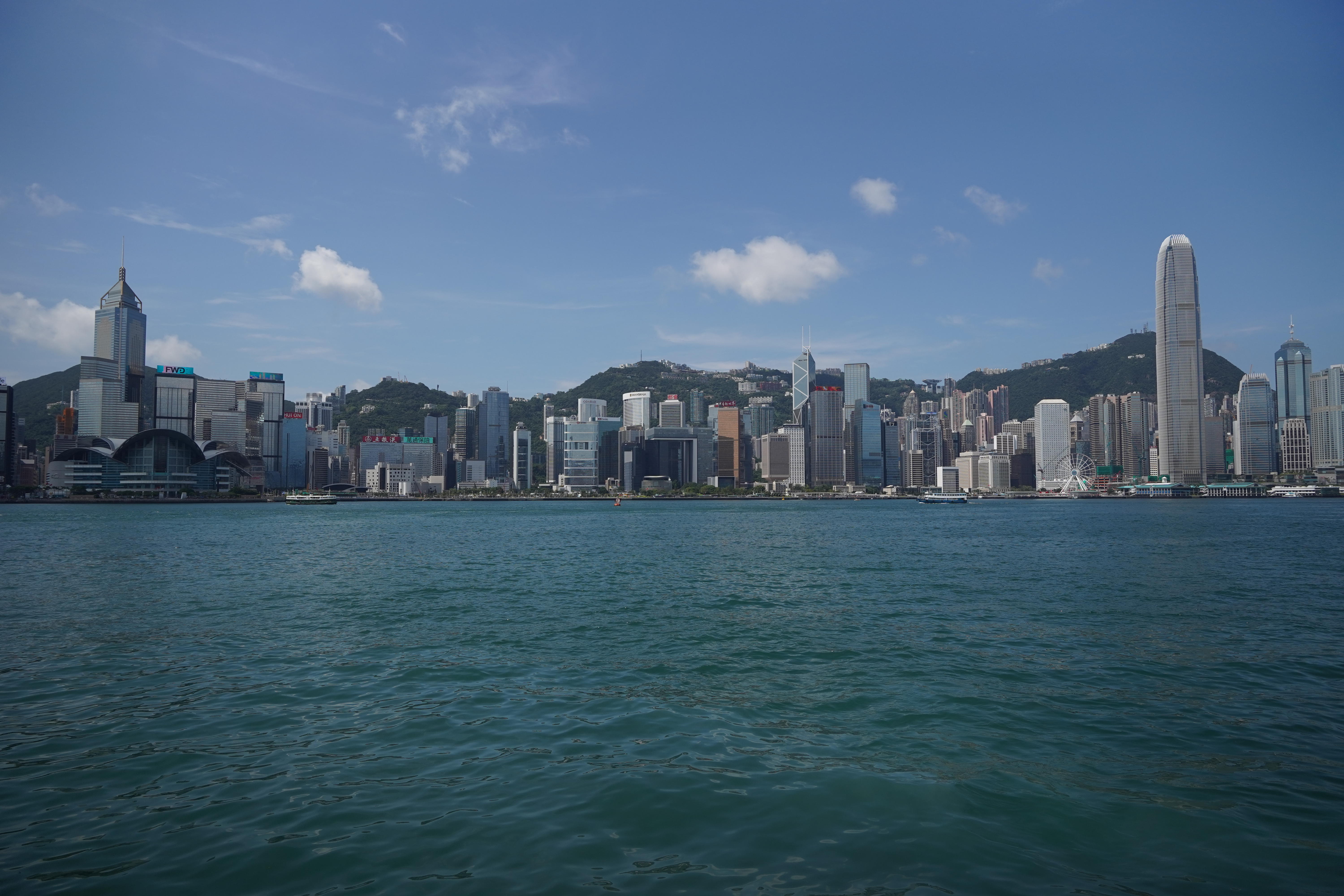
There is no need to spend the fifteen-minute break searching for a fashionable drink. Sit somewhere you are allowed to stop, watch nearby boats move in front of the distant towers, then shift your attention to the water between the two shores. Photographs can make the towers flatten the distance. Looking for a few minutes gives you a better sense of the harbour as a working stretch of water.
Along with drinking some water, check whether anyone in your group is uncomfortable in the sun. If no seats are available, pause briefly somewhere that does not obstruct people passing. Do not treat public steps or entrances as a designated rest area. This is a daytime walk, not an itinerary that ends with an evening light show. There is no need to stretch two hours indefinitely while waiting for a night view.
What to drop if time runs short
If you are still in a photo queue at 15:25, leave it and keep the time for resting and returning to the station. If you are already near a way off the waterfront, do not double back for handprints you missed. In heavy rain, a thunderstorm or strong winds, cancel the waterfront section and leave exposed areas. If you want to switch to an indoor museum, check its opening and admission conditions first. Taking shelter does not automatically become a planned, free museum visit.
There is no full meal in this walk, so have lunch before setting out. You could set aside HKD 30–60 for drinking water or a snack afterwards, with MTR travel to and from the walk budgeted separately. This is an editorial example for planning your own spending, not a price quoted by a particular shop. It also excludes boat trips, shopping and dinner.
If you want the art museum to be the focus, choose the four-hour art museum and harbour itinerary instead. It leaves time for the exhibits, which makes more sense than rushing inside at the end of this walk. For your return journey, use the Hong Kong MTR map to check the routes you need from East Tsim Sha Tsui or Tsim Sha Tsui. Allow extra time for the connecting walk inside the stations; the two station names do not mean the same exit.