Two Hours in Marunouchi: From Tokyo Station’s Brick Facade to the Streets Between the Towers
It is easy to leave Tokyo Station with just one photograph of its front. Give it two hours and you can see it differently: first notice how the long red-brick building draws people towards its entrances, then turn into Naka-dori to see how the spaces beneath tall buildings make room for walking, window-shopping and coffee. This walk does not enter the Imperial Palace or include a museum visit. It suits anyone who has just arrived in Tokyo and would rather take in the city than rush straight to another attraction, or who wants a short look around before catching a train.
If you are walking before a train journey, allow an extra margin. The route starts outside Tokyo Station’s Marunouchi Central Exit and ends at the same place. Finding a locker, collecting luggage, entering the station and reaching your platform all take additional time. If your train leaves in just two hours, shorten the walk instead of following the whole schedule.
Reach the Marunouchi side and look at the station as a building
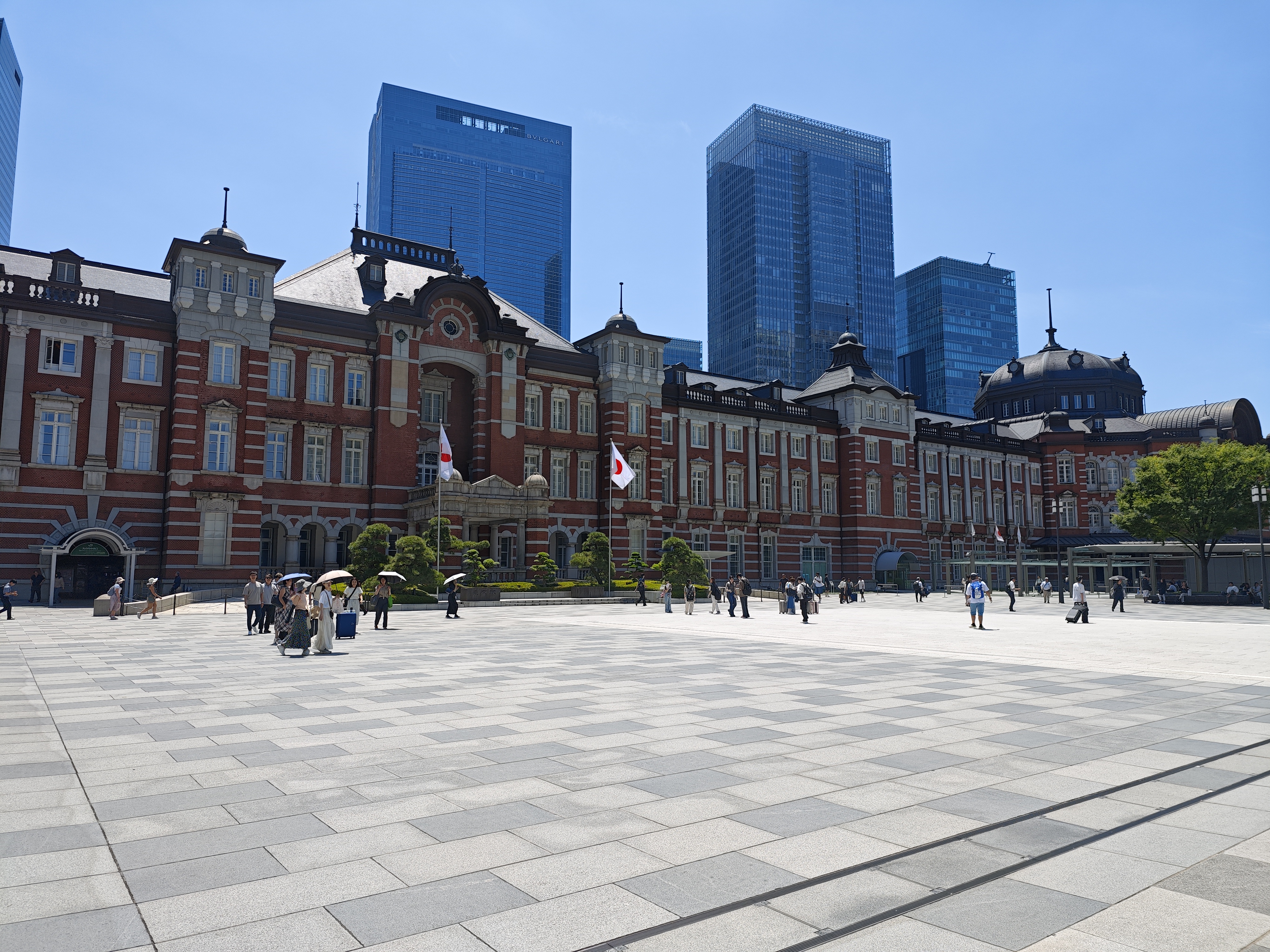
Inside the station, follow the signs towards Marunouchi. Once above ground, check that you can see the red-brick building and the station plaza. Yaesu is on the other side, and reaching an underground shopping area does not mean you have reached the start of this walk. Agree on a meeting point outside the Central Exit where your group will not block anyone, then start timing the outing.
Stand back a little in the plaza. Find the more prominent central section, then look to either side at how the windows and roof repeat, and where the pattern changes. You do not need to count every window. Choose a small section and see how the white lines divide the brick surface, and how the proportions of an entrance differ from those of an ordinary window. For a wide photograph, moving a few steps sideways to compare angles is more practical than standing in the middle of a passage waiting for everyone to disappear.
The station opened in 1914, and restoration was completed in 2012. What you see combines preserved and reconstructed elements; not every visible material is original. If the building methods interest you, Tokyo Station City’s restoration guide explains the preservation of the original brick structure on the first and second floors and the reconstruction of the exterior facing bricks. Looking again with that distinction in mind offers more than simply remembering a “century-old station.”
The South Exit dome: look up without blocking the flow
Continue along the building towards the Marunouchi South Exit. If the area outside the ticket gates is open that day and stopping is permitted, take a brief look at the decoration beneath the dome and the high windows. Do not pass through ticket gates just to see it, or stand in the stream of people entering and leaving. This is a space commuters use: the plan does not include setting up a tripod or a long photography session.
Start at the top and slowly bring your gaze down to eye level. Details high overhead can be hard to make out from the floor, whereas entrances, signs and directions need to be understood at a glance. The building has to accommodate both a sense of grandeur and everyday use. That tension is worth a few minutes of attention. Tokyo Station Gallery’s account of the station’s history, in Japanese, describes the postwar changes to the north and south domes as well as the building’s preservation and restoration. Consider the form you see today in the context of those changes.
If it is crowded or there is nowhere suitable to pause, look at the roofline from outside instead. There is another main part of the walk ahead; you do not need to spend all your time in one corner.
From KITTE to Naka-dori: notice the ground beneath the towers
Around KITTE, opposite the South Exit, look at the white facade from the public pavement, then follow neighbourhood signs towards Marunouchi Naka-dori. There is no need to go up to a roof terrace or add a shopping itinerary. Compare the station’s horizontal brick lines with the white facade, then see how the taller buildings behind enter the view. Looking closely at one building and stepping back to see the group often produce different impressions.
Use the area around Marunouchi BRICK SQUARE as your turning point on Naka-dori. Look for three small things as you walk: how much space remains between the trees, how close shop entrances are to the pavement, and where people can pause without holding up others. Do not assume that the entire street is always closed to vehicles. At junctions, follow the signals and arrangements on the day.
Slow down at BRICK SQUARE to see how its garden leaves a patch of open sky between low brick buildings and neighbouring towers. The exterior of the Mitsubishi Ichigokan Museum provides another comparison, but exhibitions inside require their own tickets and time and are not included in these two hours. The official Marunouchi street-shop map, in Japanese can help you find shops and places to eat along Naka-dori; individual businesses keep their own opening arrangements.
Two afternoon hours, including time for a drink
The example below runs from 14:00 to 16:00. It assumes you have eaten lunch, walk at an ordinary pace and have no large luggage. The minutes are editorial allowances, including movement and waiting, not a guarantee based on a timed walk.
| Time | Activity | Allowance |
|---|---|---|
| 14:00–14:25 | Find your bearings outside the Central Exit and observe the station facade | 25 minutes |
| 14:25–14:40 | Follow the building to the South Exit; look at the dome or the exterior roofline | 15 minutes |
| 14:40–14:55 | Look at KITTE’s exterior and use public pavements towards Naka-dori | 15 minutes |
| 14:55–15:15 | Walk along Naka-dori to BRICK SQUARE, observing the street and garden | 20 minutes |
| 15:15–15:40 | Find a seat, order a drink and a small snack, and rest | 25 minutes |
| 15:40–16:00 | Return in the direction you came to outside the Marunouchi Central Exit | 20 minutes |
You do not need to commit to a famous café with a queue. Check the menu and available seats first: the 25 minutes must cover finding a place, waiting and paying as well as the break. If the expected wait is more than five minutes, try somewhere nearby with seats, or bring water and sit briefly where resting is allowed. This afternoon plan assumes you have already eaten lunch. If you have not eaten, replace the 20-minute Naka-dori section with meal time, giving yourself 45 minutes for food and rest, then return directly to the station.
For one person, this walk uses public places to view building exteriors and includes no ticketed venue. You could allow JPY 1,000–1,500 for a drink and small snack. This is a personal budget, not a quoted café price; choose according to the menu. Transport, luggage storage, shopping and a full meal are separate. Bringing water lets you enjoy the architecture without that expense, and you do not need to buy something just to obtain a seat.
In rain or with less time, stay closer to the station
If finding your way on the outward walk takes 15 minutes longer than planned, shorten the stops on Naka-dori and in the garden while keeping the 20-minute return allowance. Start heading back at 15:40. Do not let another interesting shop push your turning point further towards Yurakucho. If you are tired, rest near KITTE and return to the station, leaving out BRICK SQUARE. You can still have a worthwhile walk focused on the station building.
Heavy rain makes this mainly outdoor route less rewarding. You can instead take a brief look around the station’s public areas outside the ticket gates and rest at a nearby food or drink business that is open. Do not assume unfamiliar underground passages will be a quicker shortcut. If you need a step-free approach, ask station staff which entrances and exits suit your needs, and allow extra time for lifts and finding your way.
Before setting out, use the Tokyo map to locate the station and your accommodation. Back outside the Central Exit, look up at the facade once more. You may not remember architectural terms, but if you can describe how walking here feels different from walking along Naka-dori, the two hours have given you something to keep.