Four hours at Gyeongbokgung: from gates and courtyards to Gwanghwamun Square
On a first visit to Gyeongbokgung, it is easy to spend more time finding the next building's name than looking at the spaces between them. This half-day route offers another approach. Outside a gate, notice how its opening frames your view; after passing through, see how the courtyard opens that view out. The ordered space in front of Geunjeongjeon and the more expansive water around Gyeonghoeru offer two different ways to look at architecture. Finish in Gwanghwamun Square, where the palace gate faces the present-day city.
The route suits adults visiting for the first time who enjoy building exteriors and outdoor walking. Special interior visits, hanbok photography and trying to see every ceremony need a longer plan. None is included here, and neither the National Palace Museum of Korea nor the National Museum of Korea is an additional stop.
Check the conditions for entering the palace first
Start at 09:00 outside exit 5 of Gyeongbokgung Station on Line 3, and finish at 13:00 at an entrance to Gwanghwamun Station on Line 5. The palace's transport information lists Gyeongbokgung Station exit 5 as an approach. This itinerary allows 15 minutes to walk and locate the entrance, giving more orientation time than a simple exit-to-palace walking estimate. It does not treat the route through the station as verified.
The general visiting-hours guidance lists a 09:00 opening and a usual Tuesday closure. If the closure coincides with a public holiday, it can move to a subsequent day. Closing and last-entry times vary by season. Although this is a morning visit, check the day's notices before setting out. Guard ceremonies have their own arrangements; ordinary admission does not guarantee that you will see one.
For a foreign adult aged 19–64 without an exemption, the general individual ticket is KRW 3,000. Hanbok, age and other exemptions have specific conditions. Do not budget for free entry simply because an outfit looks similar to hanbok.
First question: how does passing through a gate change the space?
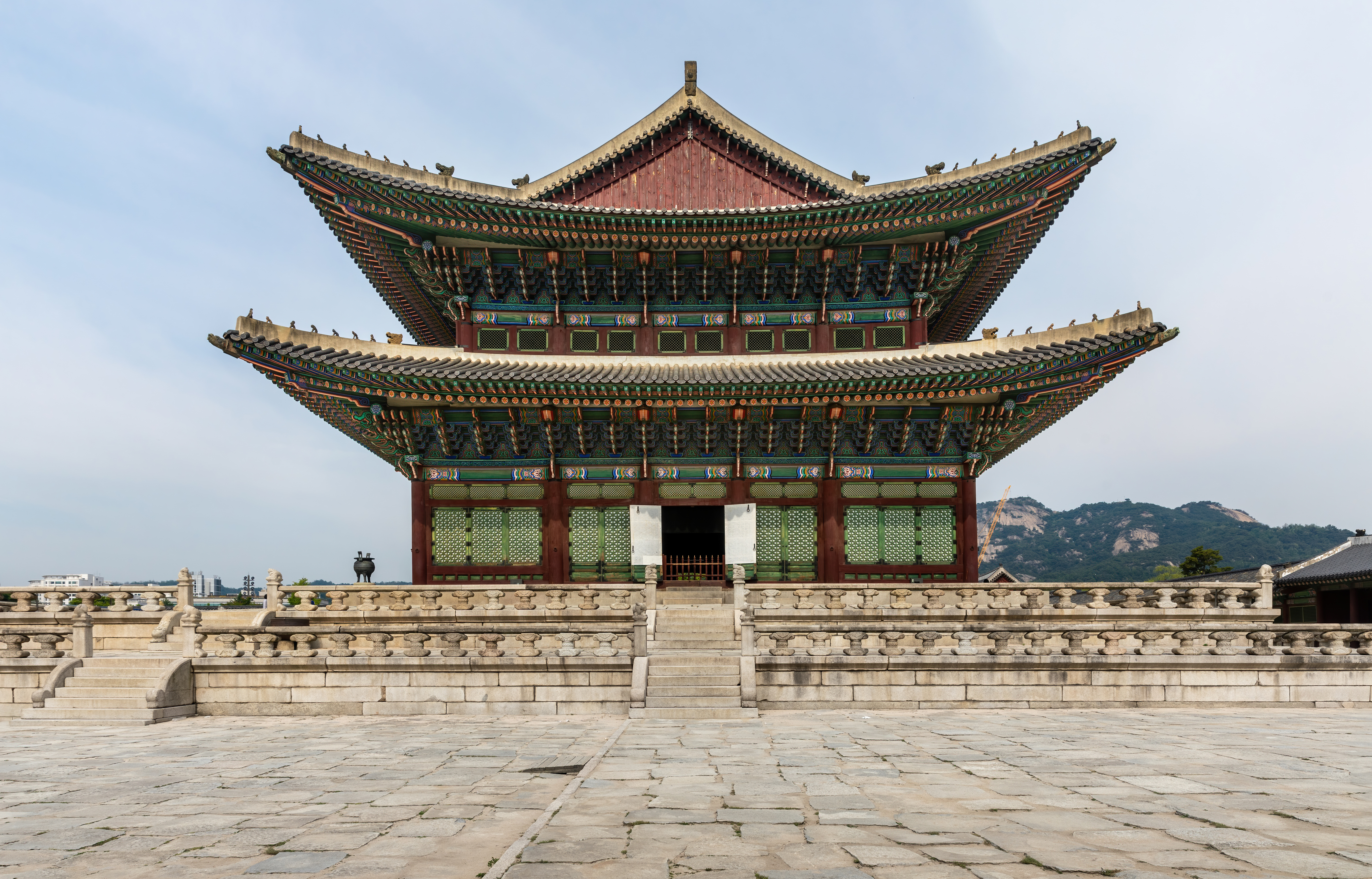
Once on the open visitor route, look at the alignment from Heungnyemun towards Geunjeongmun and Geunjeongjeon. From somewhere that leaves the path clear, frame the hall beyond with the gate in front of you. Then move towards the side of the courtyard and compare. How many layers appear when roofs that looked neatly aligned from the front are seen at an angle? This can reveal more about the space than immediately searching for the widest possible photograph.
Allow 45 minutes around Geunjeongjeon, including movement within the courtyard and reading interpretation panels. Observe the relationship between the hall and its raised base from ground that is open to visitors. Approaching the stone balustrades, climbing the terrace or entering the hall is not necessary. Consult the palace's terrace-access notice and follow the areas actually open on the day if restrictions remain in place. A path visible in a photograph is not permission to use it. Even without going onto the terrace, you can see from the courtyard how the base raises the main hall above its surroundings.
The palace has suffered destruction and undergone reconstruction; its buildings should not all be described as surviving untouched. The official history explains its role as the principal palace of the Joseon dynasty and its repeated rebuilding. When reading signs, separate the original function of a place from the restoration history of the structure now before you.
Second question: does water make a building feel more open?
Follow the garden paths open that day towards the outside of Gyeonghoeru. This part is about the exterior and the water. It does not include going upstairs or assume that a special visit is covered by the general ticket. First look at the contrast between the columns and the roof above. Then see whether reflections join the eaves and columns into another shape. If wind breaks up the water's surface, observe how the same building looks without a clear reflection.
The 35-minute stop gives enough time to compare two angles without searching the entire waterside for a spot with nobody in it. Respect barriers and do not step onto the grass for a photograph. Afterwards, keep 10 minutes for sitting and drinking water. Adding the rear palace areas or Hyangwonjeong means dropping another main stop and recalculating the time; a half-day label cannot accommodate the whole palace.
Return to the city and let the square finish the walk
After leaving the palace, head towards Gwanghwamun Square. Look back at the gate, then turn towards the modern roads and buildings. Inside the palace, gates frame what you see; in the square, nearby and distant elements enter your view together. This stop uses the ground-level public space, with no underground exhibition or event included. Follow local directions around event barriers rather than crossing a controlled area because it looks empty on a map.
Have lunch near the square, choosing after checking menus and queues. To stay within four hours, choose rice, noodles or another straightforward meal that does not require a long wait. The route does not depend on a particular famous restaurant. The 40 minutes include ordering, waiting and eating. If a restaurant warns of a long wait, changing places is more practical than squeezing the journey back.
The full four-hour time budget
These 240 minutes are editorial estimates for an ordinary walking pace, morning admission and no special activity or long queue. They are not a palace guarantee and do not include subway travel to and from your accommodation.
| Time | Plan | Minutes |
|---|---|---|
| 09:00–09:15 | Walk from the station exit to the entrance and find the visitor route | 15 |
| 09:15–09:30 | Buy a ticket and wait to enter | 15 |
| 09:30–10:15 | Look at the gates, Geunjeongjeon courtyard and interpretation | 45 |
| 10:15–10:25 | Walk towards Gyeonghoeru | 10 |
| 10:25–11:00 | Compare Gyeonghoeru's exterior, water and viewing angles | 35 |
| 11:00–11:10 | Sit and drink water | 10 |
| 11:10–11:30 | Follow open routes back out of the palace | 20 |
| 11:30–12:00 | Observe Gwanghwamun Square at ground level | 30 |
| 12:00–12:10 | Walk to a nearby restaurant | 10 |
| 12:10–12:50 | Order, wait and eat lunch | 40 |
| 12:50–13:00 | Return to a Gwanghwamun Station entrance | 10 |
If the admission wait exceeds 15 minutes, shorten the square stop from 30 to 15 minutes. If it exceeds 30 minutes, drop the square and go straight to the station after lunch. Detours inside the palace that delay your exit should also come out of square time first, preserving rest, food and the station return. Rain, snow, slippery surfaces or mobility needs may make these walking allowances unsuitable. Check an appropriate accessible route beforehand; this ordinary walking route is not a step-free guarantee.
Spending limits and choosing another day
One adult could set a personal on-site spending ceiling of KRW 25,000: KRW 3,000 for a general ticket, leaving KRW 22,000 for lunch and drinking water. This is an example limit, not a verified meal package. Subway fares, shopping, hanbok rental, paid guiding and special visits are excluded. Use actual shop prices and official information when deciding what to spend.
On a palace closure day, do not pass off a walk outside as this palace visit. Reschedule, or choose a separate short walk around Gwanghwamun and Cheonggyecheon. If you want to connect palace spaces with the uses of historical objects, a Gyeongbokgung-to-National Museum of Korea itinerary is another complete plan. It cannot simply be added after lunch while still calling this a four-hour outing.