Two hours in Jimbocho: find an old book you want to read, then sit down for coffee
Jimbocho is not more rewarding simply because you visit more shops. A name on a spine, the way a shelf is organised or a bookseller's explanation can leave a stronger memory than a tally of stops. This two-hour walk gives one antiquarian bookshop proper attention, compares it with a different kind of bookshop, then leaves time to sit down. Bring an interest: literature, history, pictures, or simply how printed books have been made and used across different periods.
Not reading Japanese does not reduce a bookshop to a place for photographs. Start with a familiar author, illustrations or foreign-language books. Decide what you would actually read before choosing what to take home. If you are looking for a particular out-of-print title, note the author, title, publisher and edition before coming. Two hours is not enough to start from scratch and search every shop's stock.
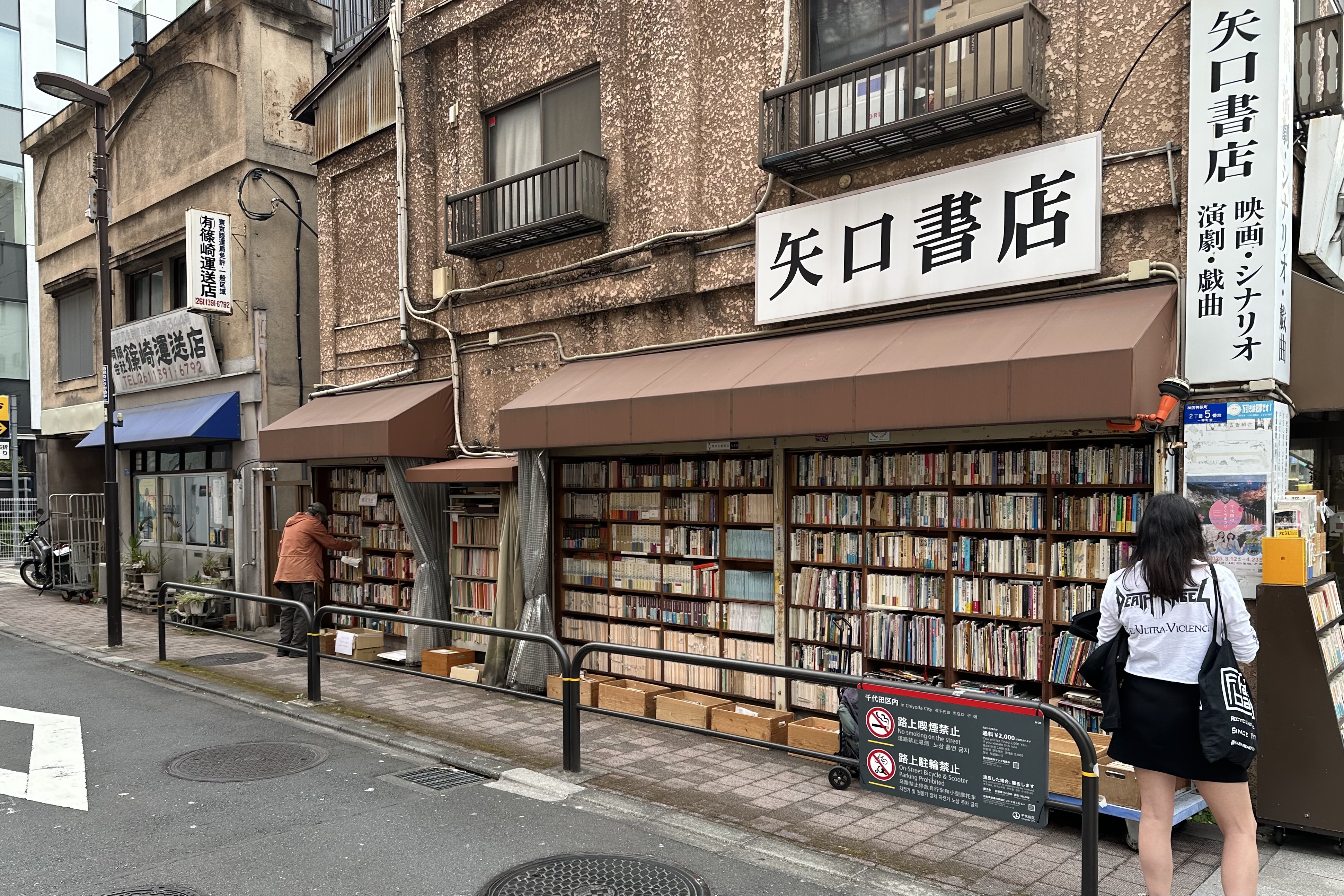
Choose the day before choosing two kinds of books
The main route uses 14:00–16:00 on a Monday to Saturday that is not a Japanese public holiday. It starts and ends outside exit A1 of Jimbocho Station. Eat lunch beforehand; this outing only includes coffee and a snack. If you need a lift, Book House Cafe's access information identifies A2 as the lift exit. Check the station's instructions that day, and allow extra time to find your way if you use A2 as your start and finish.
The first stop is Isseido Booksellers, at 1-7 Kanda-Jimbocho. Its published information lists Japanese books, foreign books and traditional Japanese books, with opening hours Monday–Saturday 10:00–18:30 and closure on Sundays and holidays. Check for changes before travelling. From the station exit, confirm the address on a street map and use the public pavement along Yasukuni-dori, crossing at designated junctions. Do not rely only on the colour of a sign or assume an entrance is unchanged because it appears in an old photograph.
The second stop is Book House Cafe on the first floor of the Kitazawa Building, 2-5 Jimbocho. It is a picture-book specialist with a café, not another antiquarian shop. Here you can bring the questions about paper, binding and reading from the first shop to contemporary illustrated books. It also gives companions who are less comfortable with long Japanese texts something of their own to explore.
In the old-book shop, look at the edition before the price
Begin by explaining the category you want to see. If unsure whether you may take down a high, valuable or wrapped book yourself, ask before pulling it out and discovering how fragile it is. Keep your bag in front and your umbrella safely stowed. Let pages open naturally rather than pressing the spine flat. A bookshop's categories help buyers find material; understanding the logic of one set of shelves is enough for a short visit.
With a book that interests you, look at three places in order. The cover shows how the work is presented. The copyright page or colophon helps identify its publication details. The contents and a few pages answer the question, “Will I really read this?” Books with the same title may have different editions, translations or bindings. Darker paper alone does not establish an earlier date or greater value.
Before buying, ask the bookseller about the condition details that matter to you: missing pages, an intact dust jacket, handwritten marks or accompanying illustrations. This is not an invitation to authenticate books yourself in the shop. It helps distinguish a decorative purchase, a reading copy and a rare-book collection. If the price exceeds your limit, note the author or edition for later research. Travelling a long way does not oblige you to buy.
You can make a small comparison without buying: choose two types of binding and see how the stiffness of the cover, thickness of the spine, and proportion of text to images affect the way a book is held and read. Ask before photographing pages or interiors. Even when making written notes, do not spread books out across a narrow passage. The pleasure here is discovering work, not turning someone else's reading space into a studio.
Move to picture books and coffee, and change your reading pace
After Isseido, follow Yasukuni-dori towards Book House Cafe. Notice the categories of shops you pass, but do not add a third lengthy browse. At the picture-book shop, choose a visual question you can follow: do colours change when the story shifts, are figures near the edge or the centre, and what makes you want to turn the page? Spending longer with one spread can give you more than photographing ten covers.
The shop's published guidance lists general bookshop hours of 11:00–18:00. The café is listed until 17:30 on weekdays, with last orders at 17:00, and until 18:00 on weekends and holidays, with last orders at 17:30; there is a year-end/New Year closure. Events may occupy part of the space. On arrival, check seating and the rules for browsing, buying and eating. Do not assume every unpurchased book may be taken to a café table. Check the shop's notices for events and opening changes.
Once seated, put your phone aside briefly and collect one thought from the visit. Did wear on a cover leave the pleasure of reading intact? Could different words beside the same picture change the story? If you bought a book, keep your drink away from it so the first coffee does not leave your new keepsake wet.
The two-hour schedule and spending limits
The following includes ordinary walking, questions and short waits. The minutes are editorial allowances, not a timed field test. Travel to the area and the time needed to leave the station are separate. Allow more flexibility around antiquarian book events and holidays.
| Time | Activity | Minutes |
|---|---|---|
| 14:00–14:10 | Find your bearings outside A1 and walk to Isseido | 10 |
| 14:10–14:45 | Choose a category and examine editions and condition | 35 |
| 14:45–15:00 | Ask questions, pay and have purchases wrapped, or organise notes | 15 |
| 15:00–15:10 | Follow Yasukuni-dori towards Book House Cafe | 10 |
| 15:10–15:25 | Choose a picture book and look at spreads and storytelling | 15 |
| 15:25–15:50 | Order a drink and snack, then sit and rest | 25 |
| 15:50–16:00 | Return to outside exit A1 | 10 |
For one person, you could set a drink-and-snack limit of JPY 1,200–1,800, then choose from the menu. This is a personal allowance, not a shop quotation. Give books a separate limit, for example JPY 3,000; this does not mean a rare book or the edition you want will be available at that price. Transport, full meals and luggage storage are separate. For a more expensive purchase, ask about wrapping and payment conditions early rather than sacrificing coffee time to a rushed last-minute checkout.
Adjust for closures, full tables and delays
Do not make Isseido a required stop on Sundays or public holidays. One alternative is the new-book selection at Sanseido’s Kanda-Jimbocho main store, followed by a break at the picture-book shop. The company’s introduction to its main store gives the address as 1-1 Jimbocho and the usual hours as 10:00–20:00. Check opening and holiday arrangements for your chosen day before going, and do not follow old directions to the temporary Ogawamachi shop. This alternative is about choosing books, not the complete antiquarian-book experience; if old books are your only reason for coming, changing the day is more suitable.
If the café is full and the expected wait exceeds five minutes, there is no need to wait for a particular name. Replace the 15-minute picture-book session with finding a nearby café that has seats, keeping the rest and return time. If an absorbing conversation in the first shop takes an extra 15 minutes, drop the picture-book comparison first rather than compressing wrapping or safe road crossings. Begin returning at 15:50. If carrying several purchases, do not add Akihabara or Ochanomizu afterwards.
In rain, deal with your wet umbrella before entering each shop. Movement between shops is still outdoors; this is not a fully covered route. Before leaving, locate Jimbocho on a Tokyo map and read the shops' opening notices. Bringing home a book you want to open again, or noting an author you want to read, can make this walk more your own than reaching the end of every street.